


Close-up lenses are an effective and inexpensive way to turn a telephoto lens into a macro lens.
What are macro lenses and what are they for?
Close-up lenses are accessories that screw onto the front of lenses like filters and allow you to focus closer.
When you attach a close-up lens to a lens, it acts in a similar way to the reading glasses of a farsighted person, who can see far away but not up close. With the lens, the camera can no longer focus to infinity, but it will still have a clear view of nearby subjects, which were previously outside its focus range.
Diopters
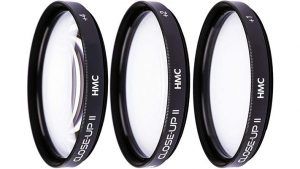
Most lenses are marked with a number with a + symbol indicating their magnification power measured in diopters.
The diopter of a lens is defined as 1000/f, where f is the focal length of the lens measured in mm. Therefore, a 50mm lens has a diopter of +20 = 1000/50, and a +4 diopter close-up lens has a focal length of 250mm = 1000/4. However, not all manufacturers mark their lenses with diopter values. For example, Canon has the 250D and 500D, with diopters of +4 = 1000/250 and +2 = 1000/500 respectively. Nikon doesn’t even print any data. Nikon’s best close-up lenses are the 3T, 4T, 5T and 6T, where the diopter value of the 3T and 5T is +1.5 and that of the 4T and 6T is +2.9.
Can close-up lenses be stacked?
Yes, although by doing so we will lose image quality and contrast. In any case, the best results will be obtained by placing the lens with more diopters first.
Close-up lenses with one or two elements
Typically, the cheapest close-up lenses are single-element (i.e., a single glass element per lens) designs. They are often sold in sets (e.g., +1, +2, and +4 diopters) and may not correct all aberrations, spherical and especially chromatic. Still, they may be the best choice for recreational or occasional use.
Dual-element lenses, while not completely free of flaws, are generally better in terms of resolution, aberration correction, and contrast. This improved quality is most noticeable at the edges of the image. That means if you’re photographing a flower, where the subject is typically in the center of the frame, a single-element close-up lens may be fine. However, if you’re photographing a flat subject that extends to the edges of the frame, a dual-element lens will provide much better sharpness, especially at larger apertures.

▌Image taken with the Canon 60D + Sigma 105mm f2.8 OS + Raynox DCR-250 lens. Photographer: Pierre Anquet
Macro lenses or extension tubes?
To a certain extent, this is a false dilemma, because they are not mutually exclusive options but rather complementary, and because the choice depends largely on the objectives we have and the magnification we wish to achieve.
Close-up lenses give better results with long focal lengths than with short ones. And the exact opposite happens with extension tubes, whose magnification ratio decreases as the focal length increases. Conventionally, the limit between both systems is usually set at 100 mm (universal step): below this, the better extension tubes; above this, the better close-up lenses.
It also depends on the working distance. If we use an extension tube with a wide angle, we will have to be very close to the subject to focus on it. And if it is an insect that can escape, it will be preferable to use a close-up lens, which also has the advantage of not reducing the amount of light reaching the sensor, something that extension tubes do. This can be essential when we need a reasonably fast shutter speed or a small aperture (or both).
On the other hand, since they do not have any optical elements, extension tubes do not affect image quality (although they can cause vignetting), while the use of close-up lenses can bring with it optical aberrations, especially at the edges, and chromatic aberrations.
If we are working with a long telephoto zoom, close-up lenses may be a better option. With tubes, we will find that the focus changes as we zoom in and out, which means that we will have to refocus continuously. That does not happen with close-up lenses: once we have focused, we can zoom in and out to change the composition, just as we can do with any normally used zoom.
If we have a macro lens and we are looking for really high magnifications, we can try the combination macro lens + extension tubes + close-up lens.
Close-up lenses or extension tubes: comparative summary
Advantages of extension tubes:
- Often, the loss in quality is minimal due to the lack of optical elements. They do not cause optical or chromatic aberrations.
- They are most useful with lenses up to about 100 mm (full frame).
- Opting for a budget option does not compromise image quality.
- They are lightweight and easy to carry. They do not need to be specially protected.
Disadvantages of extension tubes:
- They may not work with wide angles. Beyond 100 mm their magnification ratio decreases.
- They do not cause aberrations, but they can cause vignetting.
- They can interfere with electronic contacts.
- If we use a sealed camera and lens, we are likely to lose that seal when using the tubes.
- They take up a bit more space than close-up lenses.
Advantages of close-up lenses
- They do not interfere with electronic contacts.
- They do not interfere with the light reaching the sensor.
- They are more useful at long focal lengths and when working at a distance.
- They do not require us to constantly refocus when zooming.
- They take up less space than tubes.
- They are the only option with cameras that do not have interchangeable lenses.
Disadvantages of close-up lenses
- They can cause optical and chromatic aberrations.
- They give worse results with short focal lengths.
- Cheaper options compromise the quality of the photos.
- They are more delicate and need to be better protected.
Buy close-up lenses
Comparison chart
| Model* | N | Elements | TS | Val. |
|---|---|---|---|---|
| Raynox DCR-250 | 1 | 3 | 52 a 67 mm | 4.4 |
| Raynox RADCR-0150 | 1 | 1 | 52 a 67 mm | 4.2 |
| Neewer | 1 | 3 | 37 a 52 mm | 4.2 |
| Neewer | 1 | 3 | 55 a 72 mm | 4.2 |
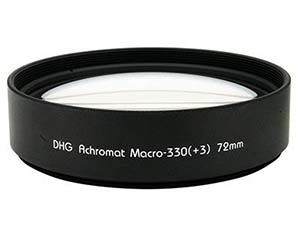
| Marumi | 1 | – | Various | 4.4 |
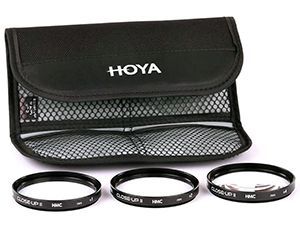
| Hoya | 3 | 1 | Various | 4.6 |
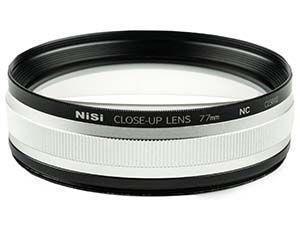
| Nisi | – | – | 49, 58, 77 | 4.5 |
| Agfa | 4 | 1 | Various | 4.2 |
| Neewer | 4 | 1 | Various | 4,2 |
| JJC | 4 | 1 | Various | 4.4 |
Includes links to Amazon
TS: thread size / N.: number of lenses / Val.: rating out of 5 from buyers
Top rated
Raynox DCR-250
3 elements in 2 groups
Adaptable 52 to 67 mm
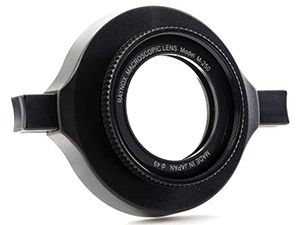
Raynox RADCR-0150
1 elemento
Adaptable 52 to 67 mm
.
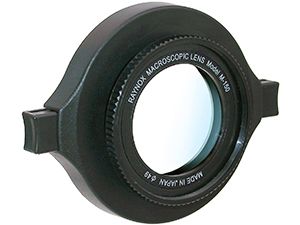
Neewer
3 elements in 3 groups
Adaptable 37 to 52 mm
.
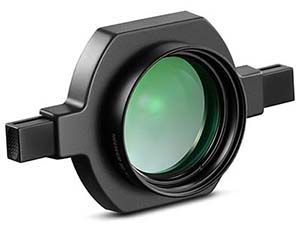
Neewer
3 elements in 3 groups
Adaptable 55 to 72 mm
Marumi
Kit lentes Hoya
Nisi
- As an Amazon Associate, this website earn from qualifying purchases.