

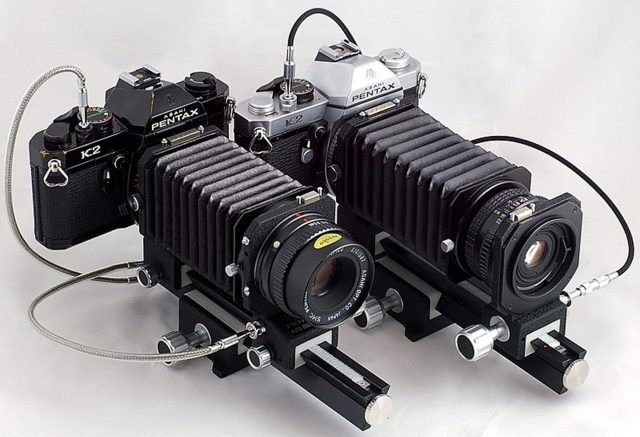
During the second half of the 20th century, almost all SLR camera brands offered good quality bellows. Today, the situation is different.
What are bellows and what are they used for in macro photography?
Bellows are instruments that are used to increase the distance between the camera body and the lens and to alter the minimum focusing distance. The principle is the same as that of extension tubes, although unlike these, bellows allow this distance to be regulated precisely and continuously. They are normally used in macro photography, but they can also be used in close-up photography, especially with long focal length lenses. And although today they seem like instruments from another era, they are still the best option when we want to use microscope lenses for extreme macro photography.
As a general rule, they allow a minimum extension of 20-30 mm and a maximum of between 150 and 200 mm. One limitation of bellows is this minimum extension, which leaves the range of possible magnifications below it uncovered.
Extension bellows adjustments

A cheap bellows with a single adjustment plane
There are good bellows and there are very bad ones – a decent one makes your life much easier than a cheap one with limited adjustability.
The best kind of bellows you can buy has at least 3 adjustable planes of movement: that of the front ring/adapter (on which the lens sits), which can be moved back and forth; that of the rear ring/adapter (attached to the camera), which can also be moved back and forth; and that of the entire mechanism (i.e. the rail where the front and rear rings sit), which again can be moved independently back and forth.
When shooting extreme macro, you need that adjustability, and most cheap bellows only allow movement of a single ring.
Two more aspects to consider are the ability to very smoothly adjust each of the movements and the ability to lock the position of the planes with a second clamping nut.
There are also other features worth considering. They are not decisive elements, but it is appreciated to have them:
- Removable rear adapter: some bellows have one; it makes the whole assembly much easier.
- Reversible mount: on one side we have the mount for our equipment and on the other an M42 thread mount for the use of vintage lenses.
- A solid and precise rail: there is no need to explain why.
- A scale to measure the extension of the bellows.
Photographing with bellows: a couple of technical aspects
Focusing
The focusing process is usually done with the lens at its widest aperture to allow enough light in. It is then switched to the chosen aperture to capture the image.
Modern cameras and lenses perform this process of opening and closing the diaphragm automatically, but most bellows do not have electronic contacts that allow communication between the camera and the lens, and focusing has to be done manually.
Sometimes, the simple act of changing the lens aperture is enough to change the plane of focus, so this is a really difficult process to control.
Depth of Field
This is by far the most difficult factor in macro photography. Depth of field is extremely narrow even when shooting at the smallest aperture that your lens allows.
Adjusting the bellows helps minimize depth of field problems with focal plane movement, although many photographers choose to use a more complex technique called focus stacking. The process involves digitally merging multiple images that have been taken by focusing at different points or with different depths of field, resulting in a final image with a larger focused area. This is a process that many modern cameras can already do on their own (up to a limited number of photos), provided the lens used is compatible with this feature.
Caring for your bellows
Bellows have traditionally been made from a combination of thin leather, synthetic leather, fabric and/or plastics, and are quite delicate. They should not be crushed and can easily be damaged if handled carelessly. To protect them, they are folded to their minimum length when stored. Any stray light entering through small cuts and holes will reduce the contrast of the photographs you take.
It is also a good idea to install the front and rear caps when not in use to prevent dust from entering. Any specks that find their way inside the bellows can easily reach the sensor or lens – the bellows suck in and blow out a considerable amount of air when their length is changed.
Buying second-hand bellows

Novoflex bellows for Sony E-Mount with electronic contacts
During the second half of the 20th century, virtually all SLR camera brands offered bellows, often of good mechanical quality, strong, rigid and very heavy. Today the situation is different. Bellows are old-fashioned instruments that the major brands have removed from their catalogues, and Novoflex is probably the only current manufacturer of high-quality (and high-priced) bellows. The rest are inexpensive and rather poorly made devices (we are talking about a precision instrument), which leads us to the second-hand market if we are looking for something in good condition.
When choosing second-hand bellows, we cannot lose sight of the fact that we are buying equipment that may be 40 or 50 years old, and it is not surprising if its best days are behind it. At best, we may find some equipment that was not sold and was forgotten on some shelf. For some models it is possible to find replacement accordions, but this is not something that can be counted on in advance.
And what alternatives do we have? If we cannot find such a bellows, we can always choose to work with a focusing rail in combination with close-up lenses or extension tubes.
Novoflex Bellows for Canon EOS
- As an Amazon Associate, this website earn from qualifying purchases.