

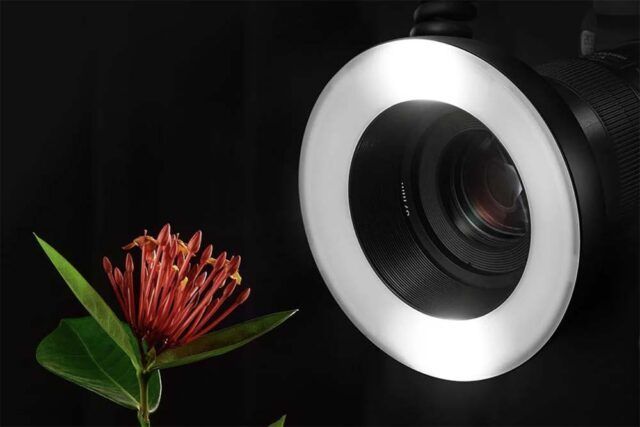
Macro photography allows you to explore tiny worlds and capture minute details that are often invisible to the human eye. However, this type of photography presents unique challenges, and one of the most important is the correct lighting of the subject. Since macro photography involves working at extremely short distances, even small errors in lighting can ruin an image. This is where macro photography flashes come into play, and, as far as this post is concerned, ring flashes, devices specifically designed to offer soft, homogeneous light without harsh shadows.
Throughout this article, we will look in detail at what a ring flash is, the characteristics of its light, its advantages and limitations, and how to get the most out of this tool.
What is a ring flash?

A ring flash is a type of circular flash that is placed around the camera lens so that light shines directly on the subject from all directions. It is intended to illuminate small objects at close range without casting harsh shadows that can eat up detail.
The ring flash was developed in the 1950s for dental and medical photography. Over time, other fields adopted it, especially macro photography. Today, there are numerous models of ring flashes, from the most basic to advanced systems with precise control of power and color temperature.
The use of light in macro photography is different from that of conventional photography.
Characteristics of ring flash light
The main attribute of a ring flash is its soft, enveloping light. Positioned directly around the lens, it illuminates from an angle very close to its axis and projects even light from all angles simultaneously, minimizing harsh shadows that can be caused by side or point light sources. Its light is also homogeneous, with all parts of the subject receiving a similar amount. This is especially useful when photographing objects with complex or textured surfaces, such as insects or flowers, where capturing detail is a priority.
The use of light in macro photography is different from that in conventional photography. Since ring flash is used at extremely short distances from the subject, it is crucial not to create overexposure zones. Ring flashes are designed precisely to handle this proximity and provide controlled light that does not burn out detail.

▌Due to its shape, ring flashes can produce ring-shaped reflections on reflective surfaces such as eyes or water droplets. While this can be a stylistic effect in some cases, in others it can be annoying and detract from the naturalness of the image. Photography: Tomer Jacobson
Advantages of using ring flash in macro photography
Along with the elimination of harsh shadows and uniformity of light, ring flash has other advantages, such as ease of use, portability, and suitability for static subjects:
- Ease of use: Ring flash is an ideal choice for those who are just starting out in macro photography or looking to minimize technical complexity while maintaining good results. With it, you don’t have to worry about placing multiple light sources or continually adjusting the direction of the flash.
- Portability and convenience: These flashes are usually lightweight and compact. Unlike more complex setups, ring flash mounts directly on the camera, a convenient option in field situations.
- Ideal for static or limited-movement subjects: Ring flash works especially well with subjects that don’t move much or that need to be captured in great detail in a controlled environment. It is commonly used in small product photography, such as jewelry or watches, and also for scientific or documentary purposes, such as medical or dental photography.
Many photographers are not convinced by the results of ring flash
Limitations and disadvantages of ring flash in macro photography
But let’s not avoid the elephant in the room: many photographers are not convinced by the results offered by ring flash. Let’s see why:
- Lack of depth: Uniform lighting can cause images to lack three-dimensionality, and the lack of contrast between light and shadow results in “flat” and volumeless photos. This effect can be partially countered by combining the flash with other light sources or modifiers, but that takes us away from ease of use.
- Unwanted reflections: As we mentioned above, these flashes can generate ring-shaped reflections, something especially problematic when photographing objects with smooth and reflective surfaces, such as glass or water droplets. Although some photographers find these reflections attractive or artistic, others seek to avoid them. To minimize them, you can use light modifiers, change the shooting angle, or combine the ring flash with natural light.
- Less flexibility in controlling directional light: Unlike other types of flash, such as dual or shoe-mounted flashes, ring flashes do not allow us to control the direction of light: their lighting is symmetrical, making it difficult to create intentional shadows or shape the light to highlight volume.
- Little use in larger scenarios: Ring flashes are designed to work at short distances. While they are perfect for small subjects and close-ups, their effectiveness decreases in wider scenes or when the subject is further away from the lens. In these cases, their light may well be insufficient.
Comparison with other types of flashes in macro photography
Ring flash vs. twin flash

▌The two flash heads (some units allow up to six) can be adjusted in angle, distance and power, making it possible to vary the lighting to suit the specific needs of each scene..
Twin flashes are systems that features two small flash heads that mount on the sides of the lens. Unlike ring flashes, they allow for greater control over the direction of light, as the two heads can be positioned independently to create subtle shadows and add volume to the subject.
While twin flashes can be more difficult to use initially, they offer the control needed to create more dramatic, three-dimensional lighting effects.
Ring flashes, on the other hand, are easier to use and provide even light without the need for complicated adjustments, making them a great choice for those who prefer a quick and easy setup.
- Learn more: Twin flashes: total control of lighting
Ring flash vs. hot shoe flash

▌The main advantage of the shoe-mount flash is its versatility. However, the challenge in macro photography is that the distance between the flash and the subject is very short, and its use can cause problems with overexposure and unwanted shadows.
The conventional shoe-mount flash is a common choice for its versatility, but it presents some challenges in macro photography. For starters, its light comes from a high angle, and it often creates unwanted shadows when working at extremely close distances. Additionally, the close proximity of the camera to the subject can make the shoe-mount flash light too intense, resulting in overexposure or blown-out areas. While it is possible to use diffusers or reflectors, this adds a layer of complexity to the process.
Ring flash avoids these problems and provides direct, even light on the subject without the need for additional modifiers.
Ring flash vs. LED light

▌LED lights are useful when continuous lighting is required, such as in product photography or macro videography.
LED continuous light is another popular choice for macro photography. Unlike flashes of any kind, LED light allows you to see how your subject is illuminated in real time, making it easier to set exposure parameters before shooting.
However, LEDs tend to be less powerful than flashes, which can be problematic if you’re shooting at small apertures (necessary to have sufficient depth of field) or in low-light environments.
Conclusion: Is a Ring Flash the Best Option for You?
Ring flash is certainly a valuable tool in macro photography, especially for those looking for a quick and effective solution to achieve even lighting without shadows. Its ease of use, portability, and ability to highlight small details make it a popular choice among nature, product, and science photographers.
However, as we’ve discussed, it’s not perfect for every situation. Its tendency to produce flatter images and limited ability to create directional shadows can be disadvantages in some cases. Therefore, it’s important to evaluate your specific needs and decide if a ring flash is the best option for you.
If you’re looking for convenience, simplicity, and want to avoid complications with more advanced light setups, ring flash might be ideal. If you prefer more control over the direction and shaping of light, twin flashes or hot shoe flashes can offer you greater flexibility.
Ultimately, the decision will depend on the type of photography you want to do and the style you want to develop. The ring flash is undoubtedly an excellent tool in any macro photographer’s kit, but it is also just one of many you have at your disposal.
Ring Flashes by System
The following compilation covers a wide range of flash options available for all major mounts. Please note that specifications may vary slightly depending on firmware versions and updates of equipment, so we recommend always checking for the latest features, checking compatibility and reading customer reviews.
Sony
The Godox MF-R76 is a ring flash, which guarantees immersive lighting without harsh shadows, suitable when looking to capture small details with uniformity. The Godox ML-150 II is also a ring flash, but it stands out for its simplicity and ease of use, being an economical option for those starting out in macro photography. It offers soft and even lighting, but with a more basic approach in terms of advanced features.
The Nissin MF18 stands out for its high level of customization and compatibility with multiple TTL systems. Its distinctive feature is its color LCD screen and its ability to adjust power precisely, making it an excellent choice for macro photographers looking for control and versatility.
Comparison table of ring flashes for Sony cameras
Slide the table to the left (smartphone)
| Model | NG | TR | Zoom | TTL | Slave | Head | Energy |
|---|---|---|---|---|---|---|---|
| Godox MF12-DK1 | 16 | 1.7 s | N/A | ADI/P-TTL | Yes (X-System, 2.4GHz) | N/A | Lithium battery |
| Godox MF-R76 (1) | 14 | 1.5 s | N/A | ADI/P-TTL | Yes (X-System, 2.4GHz) | N/A | Lithium battery |
| Godox ML-150 II | 15 | 1.5 s | N/A | Manual | No | N/A | 4x AA |
| Nissin MF18 | 16 | 4 s | N/A | ADI/P-TTL | No | N/A | 4x AA |
| Godox MF-R76 (1) | 14 | 1.5 s | N/A | E-TTL II | Yes | N/A | Lithium battery |
TR: Recycling time
Zoom: Flash range
N/A: Not applicable (not relevant or not applicable; for example, in the “Zoom” column for a ring flash it indicates that the flash does not have adjustable zoom coverage, as that feature is not relevant for that type of flash) or not available.
1: Non compatible with Sony ZV-1F
Canon
As for ring flashes, the main advantage is their ability to illuminate evenly and eliminate unwanted shadows. The Canon MR-14EX II is the benchmark for this type of flash system. Its compatibility with the E-TTL system makes it a perfect tool for those looking for precise automatic exposure. Similar in concept but much cheaper, the Yongnuo YN-14EX II offers almost identical functions, such as support for E-TTL and power settings, making it attractive for amateur photographers looking for quality without making a large investment.
The Godox MF-R76 (see table for compatibility) is another excellent example of a ring flash. It stands out for its robust construction and economical price. Finally, the Meike MK-14EXT, the cheapest of all, is more limited in advanced functions, but will more than meet the needs of those who are starting out in macro photography and are looking for a simple and functional solution.
Comparison table of ring flashes for Canon cameras
Slide the table to the left (smartphone)
| Model | NG | TR | Zoom | TTL | Slave | Head | Energy |
|---|---|---|---|---|---|---|---|
| Canon MR-14EX II | 14 | 0.1 – 5.5 s | N/A | E-TTL II | No | N/A | 4x AA |
| Yongnuo YN-14EX II | 14 | 3 s | N/A | E-TTL II | No | N/A | 4x AA |
| Godox MF-R76 (1) | 14 | 1.5 s | N/A | E-TTL II | Yes | N/A | Lithium battery |
| Godox ML150 II | 15 | 1-5 s | N/A | Manual | No | N/A | 4x AA |
| Meike MK-14EXT | 14 | 4 s | N/A | E-TTL II | No | N/A | 4x AA |
TR: Recycling time
Zoom: Flash range
N/A: Not applicable (not relevant or not applicable; for example, in the “Coverage” column for a ring flash it indicates that the flash does not have adjustable zoom coverage, as that feature is not relevant for that type of flash) or not available.
1: Non compatible with Canon EOS Rebel SL3/250D,Rebel T7/1500D 2000D,Rebel T100/3000D 4000D 200DII
Nikon
The Godox ML-150 II is a reliable choice for those looking for simplicity, efficiency, and above all, price. A step up is the Godox MF-R76, which ensures homogeneous lighting without the need for complicated adjustments.
The Meike MK-14EXT-N also stands out in this category as a budget-friendly option. Similarly, the K&F Concept KF-150 is a simple option aimed at beginners who need a ring flash with good performance for their first steps in macro photography. Although all of these budget units are basic in functions, they meet the essential requirements for capturing close-ups with enveloping light.
Lastly, the Nissin N059, a more advanced ring flash, known for its ease of use and the quality of its light. Its intuitive design and compatibility with TTL systems make it an excellent choice for photographers who want precision and control in their macro exposures without the need to manually adjust the power.
Comparison table of ring flashes for Nikon cameras
Slide the table to the left (smartphone)
| Model | NG | TR | Zoom | TTL | Slave | Head | Energy |
|---|---|---|---|---|---|---|---|
| Godox ML-150 II | 15 | 1-5 s | N/A | Manual | No | N/A | 4x AA |
| Godox MF-R76 | 14 | 1.5 s | N/A | i-TTL | Yes (X-System, 2.4GHz) | N/A | Lithium battery |
| Meike MK-14EXT-N | 14 | 4 s | N/A | i-TTL | No | N/A | 4x AA |
| K&F Concept KF-150 | 15 | 2.9 s | N/A | Manual | No | N/A | 4x AA |
TR: Recycling time
Zoom: Flash range
N/A: Not applicable (not relevant or not applicable; for example, in the “Coverage” column for a ring flash it indicates that the flash does not have adjustable zoom coverage, as that feature is not relevant for that type of flash) or not available.
Fuji
The Godox MF-R76 ring flash allows us to cast an even light around the subject, eliminating harsh shadows and ensuring accurate capture of the smallest details. It is especially useful for photographers who need consistent, glare-free light, such as in jewelry photography.
Comparison table of ring flashes for Fuji cameras
Slide the table to the left (smartphone)
| Model | NG | TR | Zoom | TTL | Slave | Head | Energy |
|---|---|---|---|---|---|---|---|
| Godox ML150 II | 15 | 1-5 s | N/A | Manual | No | N/A | 4x AA |
| Godox MF-R76 | 14 | 1.5 s | N/A | TTL | Yes (X-System, 2.4GHz) | N/A | Lithium battery |
TR: Recycling time
Zoom: Flash range
N/A: Not applicable (not relevant or not applicable; for example, in the “Coverage” column for a ring flash it indicates that the flash does not have adjustable zoom coverage, as that feature is not relevant for that type of flash) or not available.
Panasonic Lumix
The Godox MF-R76 ring flash allows us to cast an even light around the subject, eliminating harsh shadows and ensuring accurate capture of the smallest details. It is especially useful for photographers who need consistent, glare-free light, such as in jewelry photography.
Comparison table of ring flashes for Lumix cameras
Slide the table to the left (smartphone)
| Model | NG | TR | Zoom | TTL | Slave | Head | Energy |
|---|---|---|---|---|---|---|---|
| Godox ML150 II | 15 | 1-5 s | N/A | Manual | No | N/A | 4x AA |
| Godox MF-R76 | 14 | 1.5 s | N/A | TTL | Yes (X-System, 2.4GHz) | N/A | Lithium battery |
TR: Recycling time
Zoom: Flash range
N/A: Not applicable (not relevant or not applicable; for example, in the “Coverage” column for a ring flash it indicates that the flash does not have adjustable zoom coverage, as that feature is not relevant for that type of flash) or not available.
Olympus OM System
The Olympus FD-1 sets itself apart with its unique approach, using the light from the camera’s built-in flash to create soft, diffused lighting. This design makes it especially suitable for underwater photography, where even but soft light is required to avoid excessive reflections.
The Godox MF-R76 is a classic in its category, providing immersive lighting without harsh shadows, ideal for capturing fine details with uniformity. This option is perfect for product photography or macro portraits where you want to avoid harsh shadows. The Godox ML150 II, although simpler in its features, also provides soft, even light, being an affordable option for photographers looking for a ring light with solid performance but without too many technical complications.
Finally, the Meike FC110 is presented as an economical alternative among ring flashes. Although it is more basic in functions, it is an alternative to consider for those looking for something really economical but effective, especially in product photography or macro portraits.
Comparison table of ring flashes for Olympus cameras
Slide the table to the left (smartphone)
| Flash | NG | TR | Zoom | TTL | Slave | Head | Energy |
|---|---|---|---|---|---|---|---|
| Olympus FD-1 (1) | N/A | N/A | N/A | No | No | N/A | It uses the camera battery |
| Godox MF-R76 | 14 | 1.5 s | N/A | TTL | Yes (X-System, 2.4GHz) | N/A | Lithium battery |
| Godox ML150 II | 15 | 1-5 s | N/A | Manual | No | N/A | 4x AA |
| Meike FC110 | 14 | 2-5 s | N/A | Manual | No | N/A | 4x AA |
TR: Recycling time
Zoom: Flash range
N/A: Not applicable (not relevant or not applicable; for example, in the “Coverage” column for a ring flash it indicates that the flash does not have adjustable zoom coverage, as that feature is not relevant for that type of flash) or not available.
1: Compatible with Olympus TG-4, TG-5, TG-6 and TG-7
- As an Amazon Associate, this website earn from qualifying purchases.