

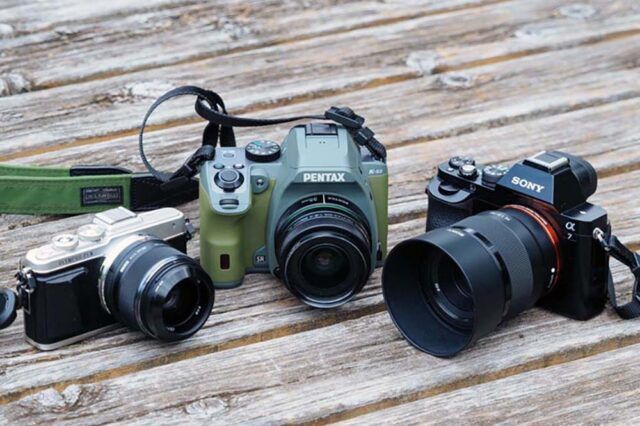
In the world of macro photography, there’s an ongoing debate: which system is more suitable—full frame, APS-C, or Micro 4/3?
When talking about sensor size, it’s often assumed (for good reasons) that “bigger is better,” but the truth is that macro photography follows its own rules. Here, factors like crop factor, depth of field, minimum focusing distance, and equipment portability carry different weights, and a more modest system can sometimes be more effective in practice than a more advanced one.
This article does not aim to declare an absolute winner or settle the debate, but rather to clearly explain what we gain and what we lose with each system.
Crop Factor and Apparent Magnification
One of the most frequently discussed—and also most misunderstood—concepts in these kinds of comparisons is the so-called crop factor. It’s often said that an APS-C or Micro 4/3 sensor “magnifies” the image or gets you “closer” to the subject, but in truth, this magnification is not optical—it’s apparent, a result of the smaller size of these sensors.
What is the crop factor, really?
The crop factor is the ratio between a camera sensor’s size and that of a full-frame sensor. It doesn’t change the actual focal length of the lens — a 60 mm is still a 60 mm — but it does affect the field of view, meaning how much of the scene is captured. An APS-C sensor with a 1.5x crop factor, and even more so a Micro 4/3 sensor (with a 2x factor), captures a narrower field of view than a full-frame sensor using the same lens.
In other words, these sensors “crop” the image area projected by the lens, as if you were closer to the subject or using a longer focal length. That’s why we talk about apparent magnification: the subject takes up more space in the frame, even though neither the lens nor the shooting distance has changed.

▌Framing simulation based on sensor size: the overlaid lines represent the apparent crop produced by each sensor type using the same lens: black for full frame, blue for APS-C, and red for Micro 4/3. The smaller the sensor, the tighter the framing becomes, without changing the lens or shooting distance.
The apparent crop from smaller sensors doesn’t magnify the image optically, but it does improve framing efficiency and detail
But is it just a crop? Not exactly
Here’s where a key concept comes into play: pixel density. It’s sometimes assumed that this tighter framing is the same as shooting with a full-frame sensor and cropping the image digitally. But that’s not quite right.
A smaller sensor, like Micro 4/3, can have the same nominal resolution (for example, 20 megapixels) as a full-frame one. But by packing those same pixels into a much smaller surface area, its pixel density increases significantly.
What does this mean? That with the same total number of pixels, the detail captured per millimeter is equal or even higher. To put it in numbers: if you took a 20 MP full-frame sensor and cropped only the area equivalent to APS-C, you’d be left with about 8.8 effective megapixels; cropping to Micro 4/3 size would leave you with just 5.2 MP. Meanwhile, a Micro 4/3 sensor uses all 20 megapixels to cover that central area from the start.
But we know what you’re thinking: this reasoning is based on a simplified assumption. In practice, many current full-frame cameras — even non-professional ones — easily surpass 24 MP. And in high-end models like the Nikon Z8 (45.7 MP) or Sony α1 II (50 MP), that resolution allows for cropped images with more detail than a 20 MP Micro 4/3 sensor can offer.
So, the pixel density advantage traditionally associated with smaller sensors is still real — just not as significant as it used to be. It all depends on the specific models being compared and the resolution of the larger sensor.
| Camera | Sensor | Total Resolution | Cropped to APS-C | Cropped to Micro 4/3 |
|---|---|---|---|---|
| OM System OM-5 | Micro 4/3 | 20.4 MP | — | 20.4 MP |
| Fujifilm X-S20 | APS-C | 26.1 MP | 26.1 MP | ~11.5 MP |
| Canon EOS R8 | Full Frame | 24.2 MP | ~10.6 MP | ~6.2 MP |
| Nikon Z8 | Full Frame | 45.7 MP | ~20.1 MP | ~11.7 MP |
| Sony α1 II | Full Frame | 50 MP | ~22 MP | ~12.8 MP |
Why is this useful in macro photography?
This combination of tighter framing and high pixel density offers a notable practical advantage: filling the frame with the subject without needing to get as close as with a full-frame camera, while maintaining or even increasing sharpness. And this is not only more comfortable, it also prevents casting shadows, disturbing an insect, or losing sharpness due to an excessively shallow depth of field.
But — and this is important — that high pixel density when working with a small sensor demands more technical precision, especially when exposing. Smaller photodiodes capture less light individually, which translates into less tolerance for overexposure (whites burn out sooner) and more noise if the image is underexposed and pushed in post-processing. In small, dense sensors, the margin for error narrows, and incorrect exposure is penalized more than in large sensors with generous pixels.
A full-frame sensor offers more editing and recovery latitude in post-processing
Depth of field: an unexpected ally in small sensors
In macro photography, depth of field is one of the biggest technical challenges. As we get closer to the subject, it shrinks drastically, to the point that even with very small apertures (f/11, f/16…), keeping the entire area of interest in focus will be impossible without focus stacking.
This is where sensor size plays a decisive role.
At the same shooting distance, aperture, and equivalent focal length, a smaller sensor offers greater depth of field. Why? Because, optically speaking, to achieve the same framing, we need to use shorter focal lengths. And shorter focal lengths yield greater depth of field.
This means that with a micro 4/3 or APS-C sensor, it’s easier (or, more precisely, less difficult) to keep an insect’s eyes, antennae, and legs all in focus simultaneously without having to stop down the aperture too much or take dozens of shots for stacking.
On the other hand, with a full-frame sensor, that same scene will require more focus precision and, almost certainly, stopping down more or taking more shots to stack in order to achieve the same depth of field. This is one reason why many macro photographers opt for systems with smaller sensors: less selective depth of field may sound attractive in portraiture, but in macro it can be a constant limitation.
That doesn’t mean full frame is at an absolute disadvantage. In close-up photography — when, in addition to the subject, we want to include some of the surroundings — its shallower depth of field can be creatively used to isolate the main subject with a softly blurred background. But if the goal is uniform sharpness across the subject’s plane, smaller sensors offer a very practical advantage.
Small sensors gain ground in macro not by raw power, but by practicality and consistency in results
Minimum focusing distance: when it matters more (and when less)
Another fundamental aspect of macro photography is the minimum focusing distance: the shortest distance at which a lens can sharply focus on a subject. This measurement does not change based on sensor size, since it depends on the optics, but its practical relevance is influenced by the system we are using.
With a smaller sensor like Micro 4/3 or APS-C, thanks to the crop factor, we get a tighter framing (more “apparent zoom”) without having to physically get as close to the subject. This means that even using a lens with the same minimum focusing distance as a full frame lens, we can fill the frame from farther away.
This advantage is very useful in field photography: it allows working with insects or other subjects sensitive to movement without scaring them, avoids casting shadows from the lens or camera body, and reduces the risk of collisions with the environment (branches, leaves, stones, etc.). It also facilitates the use of external lighting without complex setups.
In full frame systems, by contrast, we need to get physically closer to the subject to achieve the same framing, which complicates working when the environment or the subject’s behavior doesn’t allow for such proximity.
In summary: the minimum focusing distance does not change with the sensor, but the effective working distance does. And in real macro photography, that makes the difference between getting the shot or missing it.
Portability of gear: when every gram counts
In macro photography, especially outdoors or on long field trips, the portability of your gear can make as much of a difference as optical performance. It’s not the same working in a studio with tripod, rails, and flashes set up as it is to spend hours walking through a forest, crouching, crawling, or contorting yourself to capture a dragonfly, a mushroom, or flowers from a low angle.
And here, systems with smaller sensors, especially Micro 4/3, have a clear advantage.
Size and weight comparison in representative macro kits
Although each system has its variants, when comparing real combinations of camera and macro lens, it becomes clear how sensor size directly affects the weight and volume of the gear.
| System | Camera | Macro lens | Kit dimensions | Weight |
|---|---|---|---|---|
| Micro 4/3 | OM System OM-5 | M.Zuiko 60mm f/2.8 Macro | 124 x 85 x 63 mm | ~600 g |
| APS-C | Fujifilm X-S20 | Fujinon XF 80mm f/2.8 Macro | 140 x 97 x 110 mm | ~1,000 g |
| Full Frame | Canon EOS R8 | Canon RF 100mm f/2.8L Macro IS USM | 155 x 104 x 125 mm | ~1,200 g |
Micro 4/3 cameras, for example, allow the use of lightweight bodies and very compact macro lenses, while still offering advanced features like in-camera focus bracketing and stacking, in-body stabilization, or high-resolution electronic viewfinders. Some full kits — body, macro, flash, diffuser — easily fit in a small backpack, with room to spare for a sandwich. This expands opportunities for spontaneous shooting without putting too much strain on your back or limiting mobility.
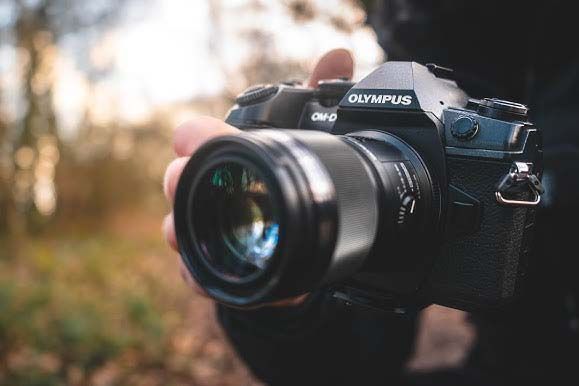
▌Field-ready lightness. A Micro 4/3 camera with the Zuiko 60mm macro makes for a compact and well-balanced setup, suitable for handheld shooting without the need for a tripod or extra accessories, even on uneven terrain or during extended hikes.
At the opposite end of the spectrum, full-frame setups are usually heavier, bulkier, and more expensive. Their dedicated macro lenses, such as 100mm or 105mm, weigh more and require sturdier camera bodies, larger batteries, and often additional supports if precise work is intended. In return, they offer clear advantages in image quality, tonal depth, dynamic range, and editing flexibility, but at the cost of reduced agility in dynamic environments or locations with limited infrastructure.

▌Power with added weight. A full-frame Canon with a 100mm macro lens delivers excellent optical quality, but its size and weight affect portability and handling, especially during long sessions or in situations that demand quick movement.
For many nature, insect, or wet and complex environment photographers, that difference in portability is crucial, which is why they find in APS-C systems—and especially in Micro 4/3—the best balance between performance, lightness, and ease of use.
Conclusion: Which system is best for macro?
La respuesta corta: depende de tus prioridades y tu forma de trabajar.
The short answer: it depends on your priorities and how you work.
Full frame still leads in image quality, ISO performance, and editing flexibility. It’s the preferred choice in studio settings or when seeking maximum detail, tonal depth, and selective blur. But it also demands more: greater focusing precision, more shots for sufficient depth of field, more weight to carry, and more technical resources to get the most out of it.
APS-C systems strike a balance: good image quality, slightly more forgiving depth of field, and more comfortable working distances than full frame. For general macro or those seeking versatility, they may be the most suitable choice.
Micro 4/3, on the other hand, shines where every gram matters: long outings, fieldwork, insect photography, or any situation where agility is key. Its deeper depth of field, lighter weight, and high pixel density at the center make it a highly effective tool in practice.
No system wins at everything. The key is understanding what you’re looking for and what you need: if absolute control is your priority, full frame is likely the right fit; if you value agility, discretion, and consistent results in the field, Micro 4/3 may be your best ally.
Comparison table
| Feature | Full Frame | APS-C | Micro 4/3 |
|---|---|---|---|
| Sensor size | 36×24 mm | Approx. 23.6×15.7 mm | 17.3×13 mm |
| Crop factor | 1x | 1.5x (Canon: 1.6x) | 2x |
| Angle of view with a 60mm | 33° | 22° | 17° |
| Working distance | Shorter to fill the frame (may scare the subject) | Moderate | Longer (more comfortable, ideal for insects) |
| Depth of field (at same aperture and framing) | Less (more blur, less focused detail) | Approx. +1 stop compared to FF | Approx. +2 stops compared to FF |
| Typical pixel density (20 MP) | ~2.4 MP/cm² | ~5.6 MP/cm² | ~8.3 MP/cm² |
| ISO performance | Better (less noise at high ISO) | Good, though slightly noisier than FF | Lower tolerance, requires precise exposure |
| Portability (weight and size) | High: large bodies, heavy lenses | Medium: good size/performance ratio | Low: very compact kits, ideal for fieldwork |
| Ideal application | Studio, macro portrait, controlled background work | Balance between quality, distance, and portability | Field photography, insects, agile situations |
Choosing a Camera for Macro: Beyond Sensor Size
Choosing a camera for macro photography isn’t just about the sensor. There are other factors that can make a difference, especially in field conditions: focusing type, stabilization, bracketing features, weather sealing, battery life, and even the viewfinder design.
In How to Choose a Camera for Macro Photography, we explore what you should consider when selecting a camera for macro, beyond just its format. Because a good tool isn’t just the one with the most megapixels, but the one that allows you to work precisely and comfortably wherever your subject may be.
- fotografiamacro.org participa en el programa de afiliados de Amazon y obtiene ingresos por las compras adscritas que cumplen los requisitos aplicables.