


The Canon PowerShot V1 is a compact camera specifically designed for content creators, with a primary focus on video recording. It was globally introduced in March 2025 with the clear goal of competing against the Sony ZV-1 II. It joins Canon’s lineup as an alternative to the EOS R50 V, a camera with an APS-C sensor and interchangeable lenses at a similar price point. This way, the brand offers users two options: a compact camera with a fixed lens or a more versatile alternative with interchangeable optics.
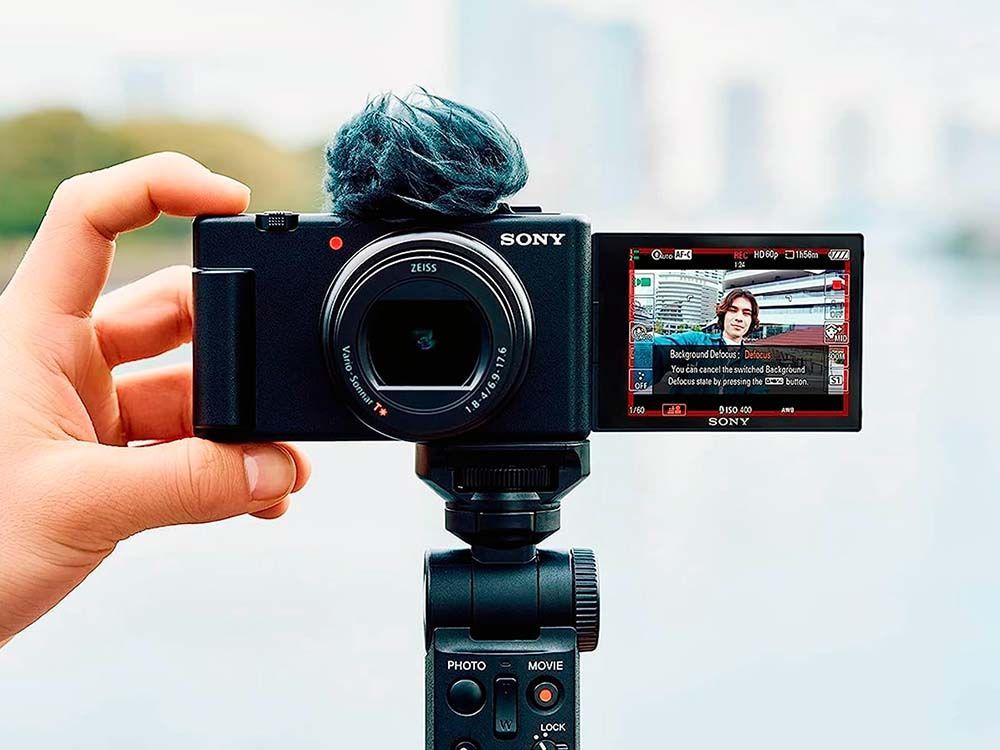
Sony ZV-1 II
Canon V1

Design and Ergonomics
The Canon PowerShot V1 features a compact and well-built body, measuring 118 x 68 x 53 mm and weighing 426 grams including the battery. While it’s slightly bulkier than the G7X Mark III—a popular reference among content creators for its portability, bright optics, and strong video performance—it remains easy to carry and fits comfortably into large pockets or small backpacks.
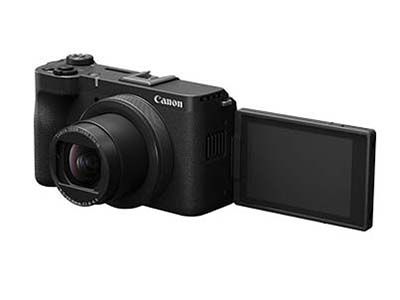
Its front grip, taller and more pronounced than on other compact models, significantly improves ergonomics: it allows for a secure three-finger hold and provides easy access to the shutter button, especially useful for extended recording sessions.
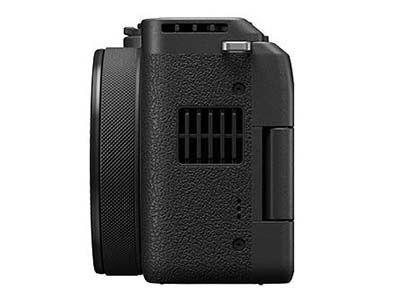
However, the design isn’t without flaws. The tripod mount is placed right next to the battery compartment door (surely for good reasons, but still), which means you have to remove the camera from the tripod every time you want to access the battery or memory card—an annoyance during intensive use. Also, while its build feels solid, the body is made of plastic, which may disappoint those expecting a more premium and refined feel in hand.
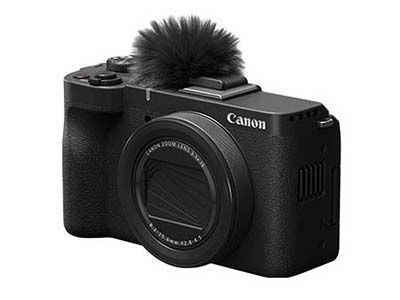
Startup is quick (about 1.5 seconds), thanks to an automatic system that extends the built-in lens (equivalent to a 16–50 mm f/2.8–4.5), which is well-suited for vlogging due to its wide angle and aperture. Additionally, it features a customizable control ring around the lens, allowing direct access to functions based on user preferences.

▌The Canon G7X Mark III (► View on Amazon), launched in 2019, became very popular among vloggers for offering a good balance between compact size, image quality, and unlimited 4K video recording. For years, it was a go-to choice for content creators looking for portability and reliable performance. The new PowerShot V1 surpasses it thanks to a larger sensor, more advanced Dual Pixel autofocus, active cooling for extended recording, and professional features like C-Log 3.
Built-in Lens: Compact and Versatile
One of the PowerShot V1’s strengths is its built-in lens, with a zoom equivalent to 16–50 mm and a variable aperture of f/2.8–4.5, ideal for handheld shooting, wide shots, close-up interviews, and indoor scenes. The 16 mm wide angle is especially useful for vlogging, as it allows you to capture yourself without needing to extend your arm or use extra accessories.
The maximum f/2.8 aperture at the wide end ensures solid performance in low-light conditions and allows effective depth-of-field control, which is especially helpful for indoor shoots or those using soft natural light. Optically, the lens delivers excellent sharpness at the center even at f/2.8 and 16 mm, with surprisingly good performance in the corners. At 50 mm and f/4.5, center sharpness remains high and improves slightly when stopped down to f/5.6, without showing significant aberrations.
However, the variable f/2.8–4.5 aperture limits the ability to create strong background blur, especially when compared to brighter lenses like the one on the Sony ZV-1 II (f/1.8–4.0). This is particularly noticeable in portraits or close-ups, where a wider aperture would help to achieve better subject-background separation. While Canon’s larger sensor partially compensates for this, the bokeh isn’t as pronounced as one might expect at the telephoto end, due to the narrower aperture.
As for minimum focus distance, it’s just 5 cm at the wide end (and 15 cm at the telephoto), allowing you to fill the frame with objects around 10 cm in size—very useful for product reviews or explanatory content. The background bokeh is mostly circular, smoother and cleaner at 16 mm f/2.8, and with more visible edges and texture at 50 mm f/4.5—common in compact lenses, but still effective for subject separation.
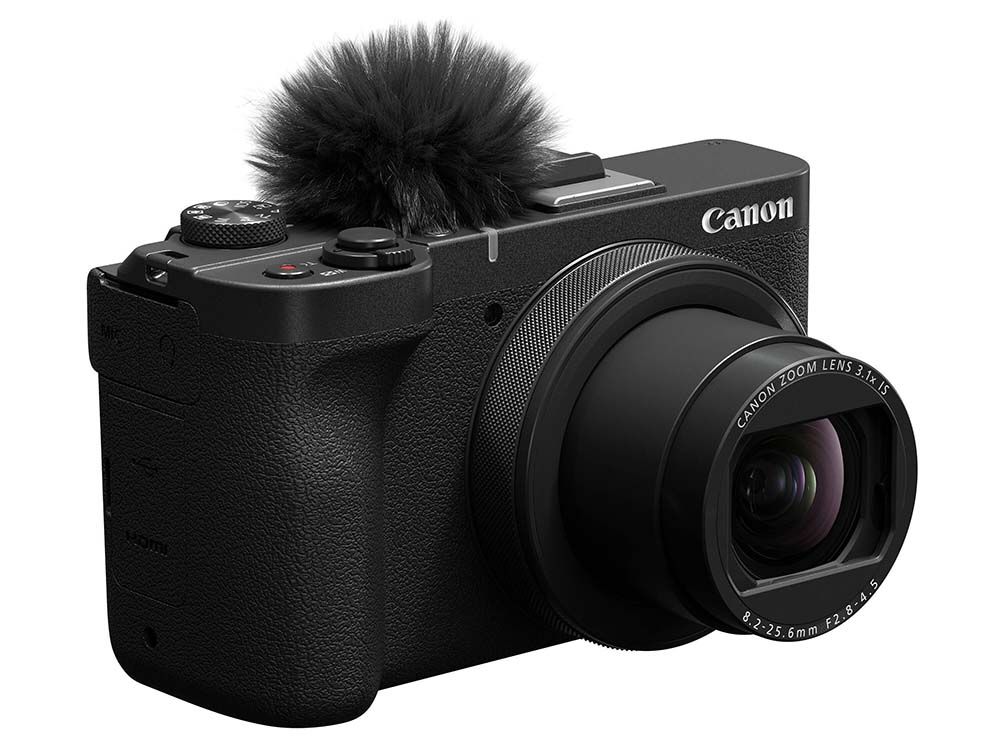
▌The built-in 16–50 mm f/2.8–4.5 lens with 3.1x optical zoom combines a wide-angle view for vlogging with a good aperture for decent low-light performance.
1.4-Inch Sensor: A Leap in Image Quality
The other major highlight of this camera is its 1.4-inch sensor, significantly larger than the typical 1” sensor found in models like the G7X Mark III or the Sony ZV-1 II. While it doesn’t reach the size of a Micro Four Thirds sensor, it comes close enough to offer a noticeable improvement in image quality, dynamic range, and performance in low-light conditions and at high ISO sensitivities.
The camera captures images up to 22 megapixels in JPEG, HEIF, and RAW formats (including compressed RAW or CRAW). It also offers lower resolution options and crop modes such as 1:1, 4:3, 16:9, and a 1.4x crop that extends the zoom to 71 mm, though it reduces resolution to 10.8 megapixels.
In terms of sensitivity, JPEG performance is progressive:
- ISO 100: clean image.
- ISO 200–400: slight loss of detail.
- ISO 800–1600: increased smoothing and reduced sharpness.
- ISO 3200–6400: noticeable loss of fine details and more visible noise.
- ISO 12800: for when there’s no other choice.
Controls and Multi-Function Shoe
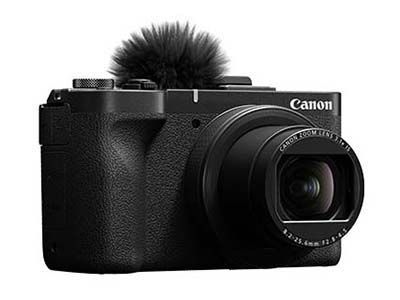
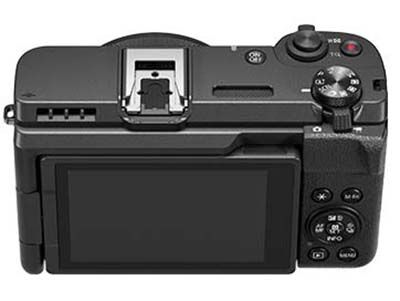
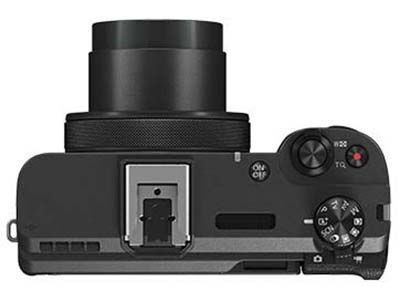
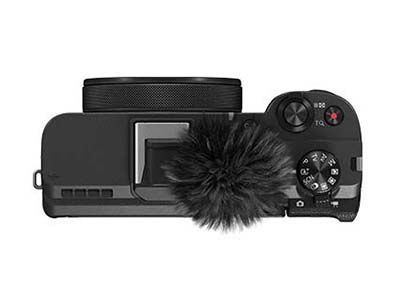
Reinforcing its video-centric design, the camera does away with the traditional pop-up flash and instead incorporates a multi-function shoe without standard connectors, specifically designed for accessories like external microphones or LED lights. It also includes a small wind filter for the built-in stereo mic by default — a practical and rare solution reminiscent of Sony’s deadcat windshields on its ZV series.
The control layout is optimized for a fast and clearly video-oriented experience. The mode dial, though compact, provides direct access to photo, video, auto, and creative modes. It’s complemented by a dedicated record button and a switch that instantly toggles between photo and video modes, making hybrid use much easier without diving into menus. However, there’s room for improvement: the PowerShot V1 lacks a third dial, which makes it harder to adjust ISO, shutter speed, and aperture simultaneously when shooting in manual mode. This limitation may frustrate advanced users seeking full exposure control without relying on quick menus or indirect adjustments.
As for photography, the V1 can shoot bursts at up to 15 frames per second using its leaf-type mechanical shutter, or up to 30 fps with the electronic shutter — offering decent potential for capturing action or candid expressions. Maximum shutter speed is 1/2000s mechanically and 1/16000s electronically, though switching between the two modes must be done manually, as the camera doesn’t alternate automatically based on lighting conditions.

▌Top view of the Canon PowerShot V1, showcasing its video-oriented design: the multi-function shoe replaces the classic flash and allows connection of accessories like microphones or LED lights. On the right, the compact dial provides direct access to key modes; the dedicated buttons for recording and quick switching between photo and video reinforce its practical focus.
Articulating Screen and Lack of Viewfinder and Flash
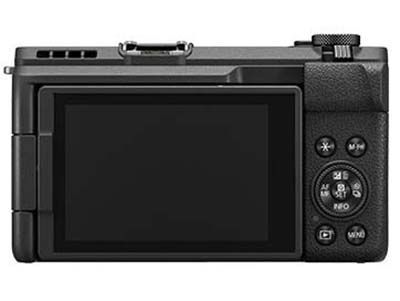
The camera features a 3-inch fully articulating LCD screen with 1.04 million dots. While its resolution isn’t the highest in its class, it offers sufficient brightness and clarity for comfortable composition, even in moderately bright outdoor settings. The full articulation allows it to flip upward, downward, or forward, making it very practical for self-recording or shooting from unusual angles. It can also be folded inward to protect the screen during transport.
As part of its minimalist and video-focused design, the PowerShot V1 omits both the electronic viewfinder and built-in flash. This helps maintain a clean, compact body, but it’s a trade-off that some users may notice — especially when shooting in bright sunlight, where a viewfinder would aid in reducing glare, or in low-light indoor situations where a basic flash could be handy in a pinch.
Active Cooling: Say Goodbye to Overheating
One of the most innovative aspects of this camera is its active cooling system. Canon has integrated a small internal fan that improves heat dissipation during extended recording. This allows for unlimited 4K recording without severe thermal restrictions—a key improvement over many compact cameras that overheat after just a few minutes of filming.
👉 This system is one of the key factors that places the V1 above rivals like the Sony ZV-1 II, which lacks active cooling and can become limited during long sessions.
Video: Versatility and Quality
In video, the PowerShot V1 records 4K up to 30 fps without horizontal crop. To record 4K at 50 and 60 fps, the camera applies a 1.4x crop, slightly limiting the framing. In Full HD, it allows recording from 24 to 120 fps, making slow-motion videos easy to create.
Additionally, Canon includes support for professional C-Log 3 recording, which offers greater flexibility for color grading during post-production—a feature highly valued by advanced users.
Stabilization, ND Filter, and Focus
The PowerShot V1 features optical image stabilization to prevent shakes during recording. It also has an internal ND filter, which helps control exposure in bright conditions and maintain optimal shutter speeds for video.
The focusing system is fast and accurate, even in close-up situations or at 50 mm f/4.5. Thanks to the Dual Pixel CMOS AF system, focusing is smooth, reliable, and steady, clearly outperforming models like the G7X Mark III, which tended to “hunt” or overfocus. This is a significant improvement, especially for video recording with frequent changes in framing or distance.
Connectivity and Battery Life
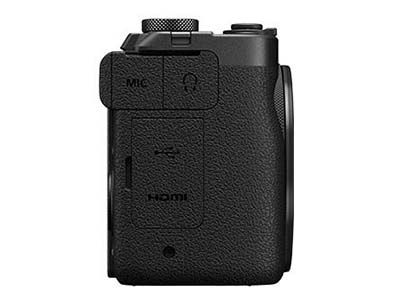
Regarding connections, the camera offers separate microphone and headphone inputs (both 3.5 mm), a USB-C port with USB 2.0 support for power and data transfer, and a micro HDMI output. The camera can function as a 1080p webcam, a useful feature for streaming and video conferencing.
Power can come from an internal LP-E17 battery or via USB Power Delivery, although the latter generates additional heat that could limit recording time. According to a review published by PetaPixel, in real tests, battery life reached about 78 minutes recording 4K at 25 fps with the fan on automatic mode—a figure to consider for those seeking long sessions.
Image Gallery

Canon PowerShot V1 vs Sony ZV-1 II: Comparison Table
| Feature | Canon V1 | Sony ZV-1 II | Usage Notes |
|---|---|---|---|
| Sensor | 1.4” (22 MP) | 1” (20.1 MP) | Canon offers better image quality and dynamic range; ideal for demanding or low-light recordings. |
| Lens | 16–50 mm f/2.8–4.5 | 18–50 mm f/1.8–4.0 | Canon provides a better wide angle; Sony has a larger aperture for bokeh and low light. |
| Stabilization | Optical + Digital | Electronic stabilization (Active SteadyShot) | Canon more effective for long handheld shots; Sony sufficient for moving vlogs. |
| Microphone | Stereo with included wind filter | Directional with included windshield | Canon captures general ambiance; Sony isolates voice better. |
| Focus (photo/video) | Dual Pixel CMOS AF | Contrast + Phase detection AF | Canon faster and more reliable in photo and video, especially with motion. |
| 4K Video | 4K 30fps no crop / 4K 60fps with 1.4x crop | 4K 30fps (slight crop) | Canon more flexible and professional, with C-Log 3; ideal for post-production. |
| Slow Motion | Full HD up to 120fps | Full HD up to 120fps | Tie. Both allow slow motion for creative shots. |
| ND Filter | Built-in | No | Canon lets you maintain ideal shutter speed even outdoors in bright sunlight. |
| Cooling | Internal active fan | No | Canon allows prolonged 4K recordings without overheating; ideal for long sessions. |
| Screen | 3.0” articulating (1.04M dots) | 3.0” articulating (0.92M dots) | Both functional for vlogging; Canon with slightly better resolution. |
| Controls & Hot Shoe | Multi-function hot shoe, mode dial, control ring | Standard hot shoe, fewer physical controls | Canon offers more customization and professional features. |
| Connectivity | USB-C, HDMI, Wi-Fi, BT, mic/headphone input | USB-C, HDMI, Wi-Fi, BT, mic input | Canon more complete, especially for audio monitoring. |
| Webcam Use | Yes (plug & play via USB) | Yes (requires setup) | Canon simpler for streaming and direct video calls. |
| Mobile Apps | Canon Camera Connect | Sony Imaging Edge Mobile | Canon more stable and versatile for remote control and transfer. |
| Vertical Recording | Automatic | Automatic | Tie. Both detect orientation and tag metadata for social media. |
| Durability (weather sealing) | No | No | Neither is sealed; caution recommended outdoors. |
| Weight | 426 g | 292 g | Sony lighter for prolonged handheld use; Canon more robust and professional. |
| Battery Life | ~78 min in 4K with fan | ~45–60 min in 4K depending on conditions | Canon more reliable for long sessions. |
| Recommended Usage Style | Professional content, interviews, long recordings, outdoors | Light vlogging, quick content, travel, social media | Canon for more serious, controlled projects; Sony for mobility and speed. |
Conclusion
The Canon PowerShot V1 marks a significant qualitative leap in the brand’s lineup and represents a clear response to the dominance Sony has held with its ZV series. It arrives at a time of renewed interest in compact cameras aimed at video, bringing strong arguments: a 1.4-inch sensor —larger than the usual 1-inch—, uncropped 4K recording up to 30 fps, active cooling for long sessions, and professional-grade features like C-Log 3 profile and Dual Pixel CMOS AF autofocus.
Compared to direct competitors like the Sony ZV-1 II, the PowerShot V1 stands out in several key aspects: its larger sensor gives it an advantage in low-light situations, the cooling system prevents overheating during long recordings, and its autofocus is more precise and reliable. Practical details such as the multifunction hot shoe and an integrated microphone with included wind filter also strengthen its professional profile within the compact segment.
That said, it’s not a camera for everyone. Its video-focused approach implies certain trade-offs: no electronic viewfinder or built-in flash, and the zoom range doesn’t reach short telephoto, limiting it for general photography. Also, its lens, while ideal for vlogging due to its wide angle, has a somewhat narrower aperture than models like the G7X Mark III or Sony ZV-1 II, requiring higher ISO in low-light scenes.
Despite these limitations, for its target audience —content creators, vloggers, streamers— the PowerShot V1 is probably the most complete and balanced compact Canon has released to date. Even its price is competitive compared to older models still selling for high prices, such as the G7X Mark II or III. Against the Sony ZV-1 II, it offers a more robust proposal in key areas like image quality, thermal management, and autofocus reliability.
That said, it’s not a camera without compromises. The plastic body feels a bit less premium; ergonomics may fall short for advanced users; and battery access is inconvenient when used with a tripod. These are areas for improvement that don’t overshadow its excellent video performance but should be considered depending on the use case.
For those prioritizing an even more compact solution or extreme portability, options like the DJI Osmo Pocket 3 might be more suitable. But if you’re looking for a true “all-in-one” compact camera with serious video tools, uncropped 4K recording, and a sensor larger than the standard, the Canon PowerShot V1 positions itself as one of the strongest and most recommended proposals right now.
Related:
Buy Canon PowerShot V1
Specs
- Sensor: 1.4-inch CMOS; effective resolution: 22.3 megapixels; ISO: 100–32,000 (photo), 100–12,800 (video)
- Lens: 3.1x optical zoom (16–50 mm equivalent); aperture f/2.8–4.5; minimum focusing distance: 5 cm (wide angle), 15 cm (telephoto); built-in 3-stop ND filter
- Video: 4K UHD up to 60 fps (1.4x crop at 50/60 fps); Full HD up to 120 fps; unlimited 4K 30 fps recording; built-in stereo microphone, external mic input, and headphone output
- Photography: JPEG, HEIF, RAW, and C-RAW formats; continuous shooting: up to 15 fps mechanical, 30 fps electronic; shutter speed: 1/2000s mechanical, 1/16000s electronic
- Screen: 3-inch articulating touchscreen LCD
- Connectivity: Wi-Fi and Bluetooth; USB-C, micro-HDMI, microphone and headphone jacks
- Battery: LP-E17, approx. 400 shots per charge
- Dimensions and weight: 118 x 68 x 52 mm; 379 g (body only), 426 g with battery
- As an Amazon Associate, this website earn from qualifying purchases.