

When you start out in photography, you quickly realize that gear doesn’t stop at the camera and lens. There’s a whole world of accessories promising to improve your photos… and plenty of chances to overspend. Among all this gear, lens filters are one accessory that’s truly worth learning about. In this quick guide, we explain what they are, what they’re for, and when they can really make a difference.
What is a camera lens filter?
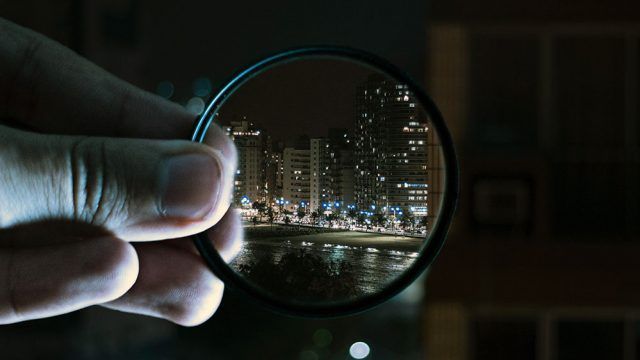
A filter is a photography accessory that is usually screwed onto the front of a lens. Although different filters serve different purposes, in general, they are used to alter the amount, direction, and type of light reaching the sensor, creating certain effects, many of which cannot be replicated by photo editing software.
The most common filters are ultraviolet (UV) filters, polarizing filters, and neutral density (ND) filters.
Ultraviolet (UV) Filters
Ultraviolet filters are mainly used to protect the lens surface from scratches, dirt, and splashes. In film photography, they are also used to eliminate the “haze effect” caused by ultraviolet light, resulting in sharper images with more natural colors (avoiding bluish casts).
In digital photography, there is much debate about the actual usefulness of these filters, as modern sensors are not sensitive to UV light. Therefore, many photographers consider them unnecessary or even counterproductive if they are low quality, as they can reduce contrast or introduce unwanted reflections.
- Learn more: Ultraviolet Filters: Do They Actually Work?
Neutral Density (ND) Filters
Neutral density filters reduce the amount of light reaching the sensor, allowing you to work with bright light sources and achieve motion effects with slow shutter speeds without overexposing your images. Essentially, just as we raise the ISO to compensate for low light, an ND filter lets us reduce exposure when there’s too much light—even if we’re already using the lowest ISO on our camera.
Reducing the amount of light hitting the sensor gives us greater flexibility and control over settings. This is useful when shooting, for example, on a clear day in the mountains, when you want to work with slower shutter speeds to experiment with motion blur, or when you want to shoot with a wide aperture to get a shallower depth of field.
ND filters are classified according to the amount of light they filter, measured in stops.
| ND Filter | Light Reduction | Approx. Transmission | Typical Use |
|---|---|---|---|
| ND2 | 1 stop | 50% | Soft light / outdoor portraits |
| ND4 | 2 stops | 25% | Moderate light / background blur |
| ND8 | 3 stops | 12.5% | Cloudy days |
| ND16 | 4 stops | 6.25% | Clear days without direct sun |
| ND32 | 5 stops | 3.12% | Partly clear skies |
| ND64 | 6 stops | 1.56% | Sunny day |
| ND128 | 7 stops | 0.78% | Intense light |
| ND256 | 8 stops | 0.39% | Direct sun / long exposure |
| ND512 | 9 stops | 0.19% | Long exposure in full sun |
| ND1000 | 10 stops | 0.10% | Prolonged exposure |
| ND10000 | 13 stops | 0.01% | Very prolonged exposure |
Filters can be stacked to combine effects, although this may cause vignetting or loss of sharpness.
For convenience, there are variable ND filters that allow you to adjust the density by rotating the filter like a polarizer.
⚠️ Variable ND filters are especially useful in video, but in long exposure photography, they can make the exact exposure time harder to calculate, and some cheap models produce visual artifacts like dark crosses.
Variable Neutral Density (ND) Filters Available on Amazon
- Variable Neutral Density Filters K&F Concept ND2-32 (various diameters)
- Variable Neutral Density Filters Gobe ND2-32 (52 mm)
- Variable Neutral Density Filters K&F Concept ND8-128 (various diameters)
- Variable Neutral Density Filters K&F Concept ND2-400 (various diameters)
- Variable Neutral Density Filters Urth ND2-400 (52 mm)
- Variable Neutral Density Filters Gobe ND2-400 (various diameters)
- Variable Neutral Density Filters K&F Concept ND2-2,000 (various diameters)
Tip: A good way to save money is to buy a filter for your largest lens diameter and use adapter rings to fit it on smaller lenses.
Adapter ring sets available on Amazon
- K&F Concept adapter rings
- Neewer adapter rings
Polarizing Filters
Polarizing filters (circular or linear, although nowadays almost all are CPL: circular polarizers) are used to eliminate unwanted reflections and improve color and contrast in images. Like polarized sunglasses, these filters allow us to see better through the glare of reflected sunlight and are especially useful in landscape and architectural photography.
A polarizer can:
- Remove reflections from non-metallic surfaces such as water, glass, or wet vegetation
- Darken the sky to make it more dramatic
- Increase color saturation, making colors more intense but natural
⚠️ Important: polarizing filters do not remove reflections on shiny metallic surfaces, such as chrome or polished aluminum.
Besides their circular screw-on version, they also come in square format, used with filter holders. This modular system is widely used in video, large format cameras, and with vintage lenses that do not allow screw-on filters.
- As an Amazon Associate, this website earn from qualifying purchases.