


Polarizing filters are one of those photography accessories that, once you try them, are hard to leave at home. Even though their effect isn’t always obvious to the naked eye, they can turn a dull image into a shot full of color, contrast, and detail. In this guide, we take an in-depth look at what they are, how they work, when to use them, and what to keep in mind to get the most out of them.
What Is a Polarizing Filter?
A polarizing filter is an optical accessory that is placed in front of the lens (screwed on, magnetic, or using a filter holder) and has the ability to filter certain directions of light. By doing so, it reduces unwanted reflections and enhances color saturation, resulting in cleaner, more visually appealing images—such as deeper blue skies or crystal-clear streams.


▌The effect of a polarizing filter is similar to that of polarized sunglasses: it lets you see beyond the glare created when light hits certain surfaces. Left: Without polarizer; right: with Urth Plus+ polarizer (Amazon link)
Linear or Circular? Types of Polarizers
There are two main types of polarizers: linear and circular (the latter often referred to as CPL, short for Circular Polarizer).
While both serve the same purpose, nearly all filters used in modern digital photography today are circular polarizers. This is because the autofocus and light metering systems in modern digital cameras can be disrupted by linear filters. CPLs include an extra layer that “reorders” the polarized light so the camera sensor can interpret it correctly.
There are also square or rectangular polarizers designed for filter holder systems. These are common in video, large-format photography, or with vintage lenses where threaded filters can’t be used. Though less common among amateur photographers, they’re a good choice for those who use multiple filters at once.
There is no standard numbering system to indicate the “strength” of polarizing filters
How Does a Polarizer Work?
Natural sunlight vibrates in many directions. When this light bounces off a surface like water, glass, or a wet leaf, part of that vibration aligns in a single direction—this is polarized light. It’s responsible for many of the distracting reflections and glare that dull an image.
A polarizing filter acts as a selective barrier that blocks this polarized light, allowing only the light that benefits the image to pass through. The result is a photo with fewer reflections, higher contrast, and more saturated colors.
What’s interesting is that the filter’s effect depends on the angle between the sun, the camera, and the scene. The strongest effect occurs when the camera is pointed at about a 90° angle to the sun. For example, if the sun is directly over your shoulder, you’re more likely to see the sky darken and reflections significantly reduce.
Additionally, CPL filters allow you to rotate the front of the filter to manually adjust the degree of polarization. This gives the photographer control over the effect, and it’s not uncommon to see a reflection literally disappear as the filter is turned.
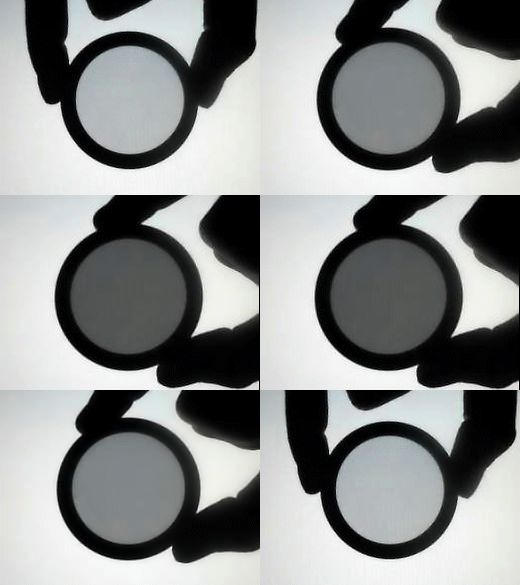
▌Animation showing how a circular polarizing filter (CPL) works: as it is rotated, the intensity of polarization changes. Source: Wikipedia.

Are There Different Intensities in Polarizing Filters?
While ND filters have a clear scale (ND8, ND64…), polarizing filters don’t have a standard numbering system to indicate their “strength.” The polarization effect isn’t tied to a fixed value; it’s adjusted manually by rotating the filter until the maximum effect is achieved.
This rotation doesn’t change the filter itself, but rather how it interacts with the angle of polarized light. That’s why the “intensity” of the effect varies depending on the scene, the position of the sun, and the shooting angle.
What does vary is the quality among brands: some filters block polarized light more effectively, retain better sharpness, or affect color less. But there’s no universal scale to measure that.
What a Polarizer Can Do for Your Photos
- Remove reflections from non-metallic surfaces: One of the most impressive uses is seeing through water. Where there was once a white reflection of the sky, now the bottom of the pond is visible. The same applies to glass or shop windows: with the filter properly rotated, the reflection almost disappears, revealing the inside.
- Increase saturation: The filter removes glare from vegetation or wet surfaces, making greens, blues, and warm tones appear deeper and more vibrant—without looking fake.
- Darken the sky: On sunny days, the filter can darken the blue sky, separating it from white clouds and creating that sought-after “dramatic” look in landscape photography.
What It Can’t Do (and What You Should Keep in Mind)
Although very useful, a polarizer isn’t a magic tool. It has important limitations:
- It doesn’t eliminate metallic reflections: if you’re photographing a chrome car or a polished aluminum surface, the polarizer won’t help. Light reflected off metals can’t be filtered this way.
- You lose light: by blocking some light, the polarizing filter reduces exposure by 1 to 2 stops. In low light conditions, this may force you to increase ISO or use a tripod.
- Uneven effect with wide angles: if you use a wide-angle lens, the sky may darken unevenly, with some areas more polarized than others. This is especially noticeable when the field of view covers different angles relative to the sun.
- It can cause vignetting if the filter is too thick or if you use very wide lenses. It’s best to look for “slim” versions to minimize this issue.
When to Use It and When Not To
A polarizer is especially useful in situations with strong reflections and direct light. For example:
- Landscapes with clear skies and bodies of water
- Wet or shiny vegetation
- Glass facades, shop windows, and large windows
- Scenes with fog or haze, to increase clarity
On the other hand, it’s best to avoid it indoors or when light is already very low, as you’ll lose even more exposure without much visual benefit.uando la luz ya es muy escasa, ya que perderás aún más exposición sin apenas obtener beneficio visual.
Practical Usage Tips
- Rotate the filter while looking through the viewfinder or screen: you’ll see the effect change in real time.
- Use the filter only when you need it. It’s not an accessory to keep on all the time.
- If you use multiple filters together (e.g., an ND and a polarizer), watch out for internal reflections or loss of quality.
Conclusion
Polarizing filters offer an effective way to control reflected light and improve the visual quality of an image. While they aren’t essential in every situation, they can add significant value in landscape, nature, or urban photography involving glass and reflections. Understanding how they work and their limitations allows you to harness their full potential purposefully.
Learn more:
Buy Polarizing Filters on Amazon
⚠️ Remember: Not all filters are the same. Some cheap filters can introduce color casts, loss of sharpness, or unwanted reflections. When buying one, make sure:
- It has a thin edge if you use wide-angle lenses
- It has good optical quality and anti-reflective coatings
A good way to save money is to buy a filter for your largest diameter lens and adapter rings to use it with smaller lenses.
Adapter ring sets available on Amazon
- K&F Concept adapter rings
- Neewer adapter rings
- As an Amazon Associate, this website earn from qualifying purchases.