


When Canon announced its first macro lens in the RF series, expectations were as high as the reputation of its L series. The Canon RF 100mm f/2.8L Macro IS USM, launched in 2021 as the spiritual successor to the revered EF 100mm f/2.8L, didn’t just promise to uphold the standard—it aimed to raise it.
With a fixed focal length of 100mm, a maximum aperture of f/2.8, up to 5 stops of optical stabilization (8 when combined with IBIS), and a weather-resistant design, this lens is clearly targeted at professional photographers and demanding enthusiasts. It weighs around 730g—something to consider if you plan to carry it and shoot handheld—and its price, around €1,450, makes it suitable for the same audience: professionals, though not entirely out of reach for serious hobbyists.
But is it only for macro photography? Not exactly. While designed with that discipline in mind, this lens also performs well in portrait, product, and nature photography.
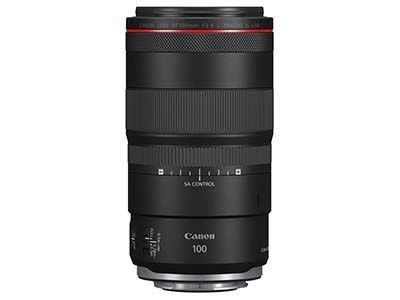
Canon RF 100mm f/2.8L Macro IS USM
Specs
- Focal length: 100mm (full-frame)
- Angle of view: 24°
- Aperture: f/2.8 to f/32
- Minimum focusing distance: 26 cm
- Maximum magnification: 1:1 (up to 1.4:1 in special mode)
- Weight and dimensions: 730 g, 117 x 75 mm
- Compatibility: Canon RF (full-frame)
Macro 1:1. Life-size and beyond
One of the main highlights of this lens is its magnification capability: it not only delivers the 1:1 reproduction ratio expected from any lens labeled as “macro,” but surpasses it, reaching up to 1.4:1 without the need for extension tubes or close-up lenses. This is made possible thanks to the built-in spherical aberration control ring. When rotated to its negative extreme, it not only alters the bokeh’s appearance but also increases the maximum magnification to 1.4x.

▌The spherical aberration control ring allows you to adjust the appearance of blur and sharpness, altering the character of the bokeh and increasing the maximum magnification.
If you’re wondering, it’s worth noting that this extra magnification is not an “electronic macro mode” nor the result of any digital trickery, but an optical consequence of the internal focusing shift caused by the variation in spherical aberration. In any case, this increase comes at the cost of a softer image (because optical blur is intentionally introduced), so it affects sharpness and you might feel like you lose on one side what you gain on the other—hence some criticisms of this feature. Some example photos are included further below.
Regarding the minimum focusing distance, it is just 26 cm, a figure that practically translates into the ability to capture details with great sharpness without having to get too close. That said, at maximum magnification, the depth of field is so shallow that you’ll need to work with a tripod or use focus stacking, or both.
Image Quality
Regarding image quality, this lens is among the best in the RF lineup in its focal range. LensTip tests show it delivers exceptional sharpness in the center from wide open, peaking between f/4 and f/5.6, where it also boasts very high corner quality.
Based on the same tests, longitudinal chromatic aberration (a weak spot in some macros) appears to be very well corrected, and lateral chromatic aberration is practically nonexistent. Distortion is imperceptible, as expected from a fixed focal length macro. Vignetting, present at f/2.8, significantly reduces at f/4 and does not overly affect overall performance.
As for halos and contrast, Canon’s ASC (Air Sphere Coating) performs very well in backlight conditions, maintaining contrast and reducing flare even in challenging scenes.
Some example images




Focus: fast, quiet, and with spherical aberration control
The focusing system is based on two Nano USM motors, a solution that allows precise and silent movements, making it suitable for both photography and video. In practice, the focus is fast and reliable, although at the shortest distances — especially near 1.4x — it can become somewhat erratic, particularly if the focus limiter is not used, which has three positions: full, 0.26 m to 0.5 m (macro), and 0.5 m to infinity.
A distinctive feature is the spherical aberration control we mentioned earlier when discussing maximum magnification. This ring deliberately modifies the shape of the bokeh and perceived sharpness. The result is a “softening effect” that can be useful in creative portraiture but is not to everyone’s taste, as it affects autofocus and results in an unnatural appearance.
The lens is compatible with focus bracketing and focus stacking functions on cameras such as the EOS R5 or R6.

▌Image taken with the spherical aberration control ring set to -4

▌Image taken with the spherical aberration control ring set to 0

▌Image taken with the spherical aberration control ring set to +4
Build and Handling: A True Professional Lens
The RF 100mm f/2.8L is built to the professional standard of the L series: high-strength plastics, metal mount, dust and moisture sealing, and a robust design that is somewhat bulky, especially compared to previous EF models. Although it feels well-balanced in hand and can be handheld thanks to its optical stabilizer, its front-heavy weight makes handling more comfortable with larger RF bodies (such as the EOS R3, R5, or R6) or with an added grip. For long shooting sessions, that extra ergonomics will be appreciated.
The focus ring is wide, smooth, and precise but uses an electronic focus system (focus-by-wire), meaning there is no direct mechanical connection and its behavior can change depending on the camera settings, affecting the feeling of control.

▌Using the RF 100mm f/2.8L is more comfortable when mounted on a body with a grip, especially in situations where stability is key.
Stabilization: 5 to 8 stops of improvement
The 5-stop optical stabilization is complemented by the IBIS in cameras like the EOS R3, R5, etc., allowing up to 8 stops of compensation. This translates to the real possibility of handheld shooting even at shutter speeds of 1/15 s or slower, something unthinkable with previous macro lenses without a tripod.
However, at maximum magnification (1.4x), even the slightest shake is noticeable, and stabilization cannot always compensate for the lack of physical support. Still, it allows much freer work in the field compared to previous generations.
Versatility Beyond Macro
Although optimized for pure macro photography, the optical and mechanical qualities of the Canon RF 100mm f/2.8L IS USM allow it to excel in other disciplines:
- Portrait: Its short telephoto focal length, combined with an f/2.8 aperture and smooth bokeh, offers excellent subject separation. The spherical aberration control ring also allows customization of the blur to achieve portraits with a more ethereal look.
- Product and Food Photography: Its sharpness and minimal distortion make it ideal for capturing tiny details, textures, and surfaces faithfully.
- Nature and Small Details: Perfect for flowers, insects, textures, or small animals. Combined with techniques like focus stacking, it delivers spectacular results even at closed apertures.
- Video: Its silent focusing via Nano USM motor, along with optical stabilization and smooth, natural background blur, make it useful for close-ups, detail shots, or interviews where the background should not distract.
Alternatives
Canon
- RF 85mm f/2 Macro IS STM: lighter and more affordable (~600 €), with 1:2 macro, stabilization, and good optical quality, but without weather sealing or comparable sharpness.
- EF 100mm f/2.8L IS USM (EF mount, via EF-RF adapter): similar basic performance, but without spherical aberration control or 1.4x magnification.
Third-Party Brands
- Laowa 100mm f/2.8 2x Ultra Macro (RF): fully manual (no AF or stabilization), but with 2:1 magnification. Optically very solid; ideal for extreme macro with tripod, less suited for general use.
- Tamron SP 90mm f/2.8 Di VC USD Macro (EF mount, via EF-RF adapter): a classic Canon macro reference, with stabilization (VC), 1:1 magnification, and good overall performance.
- Sigma 105mm f/2.8 EX DG OS HSM Macro (EF mount, via EF-RF adapter): another classic macro, stabilized, with HSM AF, good bokeh, and sharpness. Somewhat outdated compared to newer models (more modern versions exist for Sony and L-mount, but not for Canon).
- Samyang 100mm f/2.8 ED UMC Macro (EF mount, via EF-RF adapter): manual, affordable, and optically very competent. Offers 1:1, good contrast, and smooth focusing, though without stabilization or automation.
Comparative table of alternative macro lenses
Slide the table to the left
| Lens | Mount | Magnification | AF | Stabilization | Weight | Notes |
|---|---|---|---|---|---|---|
| Canon RF 100mm f/2.8L Macro IS USM | RF | 1.4x | Yes (Nano USM) | Yes (Hybrid IS) | 730 g | SA control, weather-sealed, high sharpness |
| Canon RF 85mm f/2 Macro IS STM | RF | 0.5x | Yes (STM) | Yes | 500 g | Affordable, no weather-sealing or 1:1 |
| Canon EF 100mm f/2.8L IS USM (adapted) | EF | 1.0x | Yes (USM) | Yes (Hybrid IS) | 625 g | Classic, no SA or 1.4x |
| Laowa 100mm f/2.8 2x Ultra Macro | RF | 2.0x | No | No | 650 g | Extreme macro, 100% manual |
| Tamron SP 90mm f/2.8 Di VC USD | EF (adapted) | 1.0x | Yes (USD) | Yes (VC) | 610 g | Good IS and sharpness, classic |
| Sigma 105mm f/2.8 EX DG OS HSM | EF (adapted) | 1.0x | Yes (HSM) | Yes | 725 g | Versatile, but somewhat outdated |
| Samyang 100mm f/2.8 ED UMC Macro | EF (adapted) | 1.0x | No | No | 705 g | Good optics, 100% manual |
► For more information about these and other lenses, check out Full range of macro lenses for Canon EOS (Full Frame and APS-C)
Conclusion
The Canon RF 100mm f/2.8L Macro IS USM is a technically outstanding lens that more than meets the expectations of a professional macro: excellent sharpness, true 1:1 magnification (and beyond), minimal distortion, good optical performance even in demanding conditions, and a robust build typical of the L series.
Its most unique feature — the spherical aberration control ring — is an interesting creative tool, though it will divide opinions due to its impact on sharpness and autofocus. It’s not just a decorative addition, but requires a good understanding of how and when to use it, and it’s hard to see it as a strong buying argument.
Despite its macro focus, the lens is versatile. It performs equally well in portrait, product, or nature photography, as long as its size, weight, and price are taken into account. The electronic focusing (focus-by-wire) and its less predictable behavior near maximum magnification can be occasional limitations depending on the type of use.
Buy the Canon RF 100mm f/2.8L Macro IS USM
Canon RF 100mm f/2.8L Macro IS USM
Complete technical specifications
- Mount: Canon RF
- Focal Length: 100 mm
- Maximum Aperture: f/2.8
- Minimum Aperture: f/32
- Optical Construction: 15 elements in 12 groups, including 1 UD (Ultra Low Dispersion) lens and 2 aspherical lenses
- Number of Diaphragm Blades: 9 (circular aperture)
- Minimum Focus Distance: 0.26 m
- Maximum Magnification: 1.0x (life-size reproduction)
- Image Stabilization: Yes; up to 5 stops compensation with optical stabilizer in the lens, and combined stabilization with the body (Dual Sensing IS)
- Focus Motor: Nano USM Motor (Ultrasonic Motor)
- Internal Focus: Yes
- Focus Limiter: No physical focus limiter
- Stabilization Switch: Yes
- Customizable L-Fn Button: Yes, includes customizable button and control ring
- Filter Thread: 67 mm
- Dimensions: 75 mm diameter x 117 mm length
- Weight: 730 g (without caps or hood)
- Weather Resistance: Yes; sealed against dust and moisture
- Front Element Coating: Fluorine coating to repel water, oil, and dust
- Included Accessories: Front and rear caps, ET-73B hood, protective pouch
- As an Amazon Associate, this website earn from qualifying purchases.