


If you don’t feel like reading and just want to see the lenses, follow these links:
The Canon ecosystem for macro photography stands out for offering a wide range of lenses for both enthusiasts and professionals, compatible with full-frame and APS-C cameras.
One of the advantages of Canon lenses is their compatibility with sensors of different formats, allowing users to adjust focal length and depth of field depending on the gear and desired macro photography style. Additionally, Canon features technologies such as Optical Image Stabilization (IS) and ultrasonic (USM) or stepping motors (STM), which make handheld shooting and tracking moving subjects easier.
The Canon lineup includes everything from classic 1:1 macro lenses to specialized options with higher magnification, weather-sealed optics, and built-in stabilization—ideal for nature, product, or scientific photography.
Moreover, the Canon system also supports a wide variety of third-party lenses from brands like Tamron, Sigma, Laowa, and Samyang. These alternatives often range from versatile autofocus and stabilized options to specialized lenses for extreme macro or creative photography. They are generally well regarded for offering great value for money and expanding both technical and artistic possibilities within the Canon ecosystem, especially for EF mount.
Canon Full Frame: native macro lenses (EF and RF)
Shortlist: Which Canon full frame macro lens to choose based on your profile
For those just starting in macro and valuing versatility, the Canon RF 85mm f/2 Macro IS STM is a lightweight and affordable option. Though it doesn’t reach 1:1 magnification, its 1:2 ratio is sufficient for everyday details, and the f/2 aperture makes it a useful portrait lens as well. Built-in stabilization allows for easy handheld shooting, and the STM focus motor is quiet and smooth. Ideal as a hybrid lens for those not exclusively focused on macro. Note: Since it doesn’t offer full magnification, it may fall short for small subjects or more technical macro work..
For advanced photographers who treat macro as a key part of their work, the Canon RF 100mm f/2.8L Macro IS USM is the go-to choice. With up to 1.4x magnification, hybrid stabilization, weather-sealed construction, and excellent optics, it provides everything needed for professional results both outdoors and in the studio. Its spherical aberration control ring adds a creative layer to bokeh manipulation but requires practice. Note: Its price, weight, and complexity make it less suitable for casual users.
For professionals pursuing extreme macro or scientific photography, the Canon MP-E 65mm f/2.8 1-5x Macro is one of a kind. It allows magnification up to 5:1 without accessories, but demands manual focus, tripod use, and complete lighting control. It’s a highly specialized tool capable of stunning results in expert hands. Note: Steep learning curve and limited strictly to extreme macro use.
For photographers on a tight budget using full-frame cameras, an affordable alternative is the Canon EF 50mm f/2.5 Compact Macro. While originally designed as an EF lens for DSLRs, it remains fully compatible with full-frame mirrorless bodies via an adapter. It offers 1:2 magnification and decent sharpness for its price—ideal for those wanting to explore close-up photography without a big upfront investment. Note: No image stabilization, no weather sealing, and basic build quality make it an entry-level option not intended for professional demands.

▌Our pick: The Canon RF 100mm f/2.8L Macro IS USM is the top choice for those looking for a macro lens in the Canon system. It offers 1:1 magnification with a comfortable working distance and hybrid stabilization—perfect for handheld shooting. It stands out for its high optical quality, good aberration control, and fast, silent autofocus. Its sturdy build makes it a reliable option for professional use in macro and product photography.
Over time, Canon has developed a full-frame lineup centered around the 100mm range, with various iterations covering both the professional and advanced enthusiast segments. Unlike with APS-C, the focus here is more on working distance and maximum image quality, including options with stabilization, optical improvements, and advanced features.
Canon’s logic in this segment has been:
- A basic 100mm macro (EF 100mm f/2.8 USM), affordable, sharp, and versatile.
- A stabilized and more refined 100mm (EF 100mm f/2.8L IS USM Macro), with improved optics and a hybrid IS system that’s very useful for handheld macro.
- A technological leap with the new RF 100mm f/2.8L Macro IS USM, which not only improves the optical design but also adds native 1.4:1 magnification, more precise electronic focusing, and more effective aberration correction.
In all cases, the 100mm focal length is the most balanced for macro on full frame: it offers a comfortable working distance, good compression for portraiture, and enough versatility to be used beyond macro photography (portrait, detail, even landscape).
Additionally, all of these lenses work perfectly on APS-C bodies (equivalent to 160mm), providing even greater working distance and apparent magnification, making them extremely useful for those with secondary or hybrid smaller-format cameras.
The only real weak point in Canon’s own lineup is the lack of alternatives at different focal lengths: the brand does not offer native 150mm macro lenses or creative focal lengths below 65mm in full frame. For that, you need to turn to Laowa, Sigma, Tamron, etc. One exception: those looking for something more experimental or extreme can consider the MP-E 65mm f/2.8 1–5x, a one-of-a-kind lens that allows for extreme macro without external accessories, but it’s fully manual and has a steep learning curve.
Comparison table of all macro lenses for Full Frame
| Mount | Brand | Model | Macro | AF/Manual | Stabilization | Format |
|---|---|---|---|---|---|---|
| RF | Canon | RF 35mm f/1.8 IS STM Macro | 1:2 | STM AF | Yes | Full Frame |
| RF | Canon | RF 50mm f/2.5 Compact Macro | 1:2 | STM AF | No | Full Frame |
| EF | Canon | EF 50mm f/2.5 Compact Macro | 1:2 | USM AF | No | Full Frame |
| EF / RF | Canon | EF 100mm f/2.8 Macro USM | 1:1 | USM AF | No | Full Frame |
| EF / RF | Canon | EF 100mm f/2.8L IS USM Macro | 1:1 | USM AF | Yes | Full Frame |
| RF | Canon | RF 100mm f/2.8L IS USM Macro | 1.4:1 | USM AF | Yes | Full Frame |
| EF | Canon | MP-E 65mm f/2.8 1-5x Macro | 1–5:1 | Manual | No | Full Frame |
| EF | Canon | EF 180mm f/3.5L Macro USM | 1:1 | USM AF | No | Full Frame |
| EF / RF | Laowa | 24mm f/14 2× Macro Probe | 2:1 | Manual | No | Full Frame |
| EF | Laowa | 25mm f/2.8 2.5–5× Ultra Macro | 2.5–5:1 | Manual | No | Full Frame |
| EF | Laowa | 60mm f/2.8 Ultra Macro APO | 2:1 | Manual | No | Full Frame |
| EF | Laowa | 85mm f/5.6 Ultra Macro APO | 2:1 | Manual | No | Full Frame |
| EF | Laowa | 90mm f/2.8 Ultra Macro APO | 2:1 | Manual | No | Full Frame |
| EF | Laowa | 100mm f/2.8 Ultra Macro APO | 2:1 | Manual | No | Full Frame |
| EF | Laowa | 15mm f/4 Wide Angle Macro | 1:1 | Manual | No | Full Frame |
| EF | Samyang | 100mm f/2.8 ED UMC Macro | 1:1 | Manual | No | Full Frame |
| EF | Sigma | 105mm f/2.8 OS HSM Macro | 1:1 | HSM AF | Yes | Full Frame |
| EF | Sigma | 150mm f/2.8 HSM Macro | 1:1 | HSM AF | Yes | Full Frame |
| EF | Tamron | 90mm f/2.8 Di VC USD Macro | 1:1 | USD AF | Yes | Full Frame |
| RF (adapted EF) | Tamron | 90mm f/2.8 VXD Macro | 1:1 | Fast AF | No | Full Frame |
| EF | Irix | 150mm f/2.8 Dragonfly Macro | 1:1 | Manual | No | Full Frame |
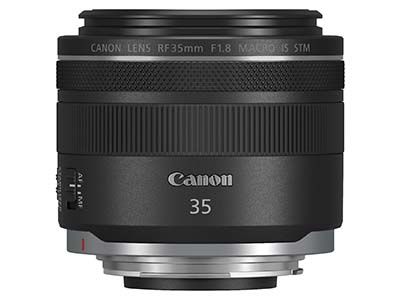
Canon RF 35mm f/1.8 IS STM
Specs
- Focal Length: 35 mm (equivalent to 56 mm on APS-C format)
- Angle of View: 63°
- Aperture: f/1.8 to f/22
- Minimum Focus Distance: 17 cm
- Maximum Magnification: 0.5x (1:2)
- Weight and Dimensions: 305 g, 69 x 62 mm
- Compatibility: Canon RF mount (Full Frame and APS-C)
Analysis
This lens is peculiar within the Canon macro family because it doesn’t reach 1:1 magnification (it stays at 0.5x), but it is marketed as “macro,” and it is in the broad sense of the term: it allows sharp close-ups with close focusing.
Its great virtue is versatility. You can use it as a lightweight wide-angle for street photography, landscapes, or travel, and then get very close to photograph details: flowers, food, textures, small objects, products…
However, it’s not a true macro. When photographing really small subjects, its low magnification and short working distance (you are very close to the subject) become a problem. It also lacks the level of optical correction or sharpness found in 1:1 lenses with longer focal lengths. Still, for someone who wants a “daily” macro, discreet, lightweight, and very affordable for what it offers, it’s an excellent choice.
Ideal use: Street photography, food, travel.
Limited use: Small insects, stacking, or technical work.
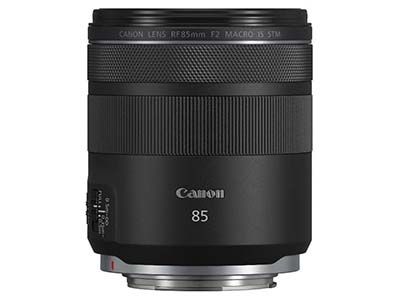
Canon RF 85mm f/2 Macro IS STM
Specs
- Distancia focal: 35 mm (equivalente a 56 mm en formato APS-C)
- Ángulo de visión: 63°
- Apertura: f/1.8 a f/22
- Distancia mínima de enfoque: 17 cm
- Magnificación máxima: 0.5x (1:2)
- Peso y dimensiones: 305 g, 69 x 62 mm
- Compatibilidad: Montura Canon RF (Full Frame y APS-C)
Analysis
The Canon RF 85mm f/2 Macro IS STM is one of the most versatile and affordable lenses within Canon’s full-frame mirrorless system. Although its name includes the word “Macro,” it is not a macro lens in the strict sense, as its magnification reaches up to 1:2, not the standard 1:1. However, this technical limitation is balanced by a clearly hybrid focusing approach: it is both a useful tool for detail photography and an excellent lens for portraits and general use.
Its 85mm focal length offers a soft background compression, ideal for portraits with attractive bokeh. The f/2 aperture allows working with good depth of field and in low light conditions, while the built-in optical stabilization system (up to 5 stops, more if combined with stabilized bodies) makes handheld shooting possible even at slow shutter speeds. The STM autofocus, smooth and silent, also makes it suitable for video, especially for light or discreet recordings.
In detail photography, it delivers sharp and appealing results, perfect for food, product, flowers, or small everyday objects. Its compact size and light weight make it a comfortable choice to always carry in your bag, ideal for travel or street photography without drawing too much attention.
That said, it’s not a lens designed for extreme macro or technical work. It doesn’t have 1:1 magnification or weather sealing, and its close focusing, although precise, is not designed for stacking or very small subjects like insects.
Ideal use: Portrait, street photography, food, everyday details, travel.
Limited use: Technical macro, small insects, stacking, precision work with 1:1 magnification or higher.
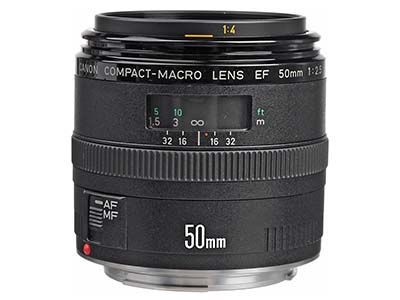
Canon EF 50mm f/2.5 Compact Macro
Specs
- Focal length: 50 mm (equivalent to 80 mm on APS-C format)
- Angle of view: 46°
- Aperture: f/2.5 to f/32
- Minimum focusing distance: 23 cm
- Maximum magnification: 0.5x (1:2)
- Weight and dimensions: 280 g, 67.6 x 63 mm
- Compatibility: Canon EF mount (Full Frame and APS-C)
Analysis
This is a somewhat forgotten lens from another era, but it has a particular charm. Not just because of its (truly compact) size, but because it delivers very good central image quality and has a classic, even slightly vintage look.
That said, it’s not practical for most modern macro uses: it only goes up to 0.5x, and to reach 1:1 you need to add a converter (the Life-Size Converter, which is hard to find and expensive today), complicating everything and breaking its compact design.
On full frame, 50mm already means a very short working distance. You have to get so close that you’ll scare off any insect. What it can do is tabletop photography—small but not tiny objects (stamps, watch parts, paper money)—or even portraits with a nice bit of background blur. But in practice, it holds more nostalgic than functional value today.
Ideal use: Small studio objects, collecting.
Limited use: Outdoors, nature, extreme macro.
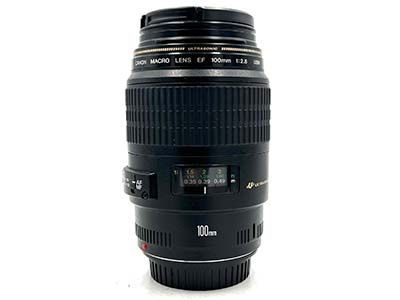
Canon EF 100mm f/2.8 Macro USM
Specs
- Focal length: 100 mm (equivalent to 160 mm on APS-C format)
- Angle of view: 24°
- Aperture: f/2.8 to f/32
- Minimum focusing distance: 31 cm
- Maximum magnification: 1x (1:1)
- Weight and dimensions: 600 g, 78.6 x 118.6 mm
- Compatibility: Canon EF mount (Full Frame and APS-C)
Analysis
This has been the workhorse of macro photography for Canon for over a decade. An affordable, reliable lens with true 1:1 macro capability and a decent working distance.
Its build is neither weather-sealed nor premium, but it’s robust and lightweight. On full-frame cameras, it offers an ideal distance for insects and botanical details without needing to get too close to the subject. It has also become a popular alternative for portrait work, thanks to its smooth bokeh.
Its biggest drawback today is the lack of image stabilization. In macro photography, where even the slightest movements matter, that can make handheld or low-light shooting tricky. It’s also not the fastest focusing lens (the USM motor is good, but a bit clunky with moving subjects). Still, for its price-to-performance ratio, it remains a very solid choice.
Ideal use: Insects, plants, occasional portraits.
Limited use: Macro in low light without a tripod.
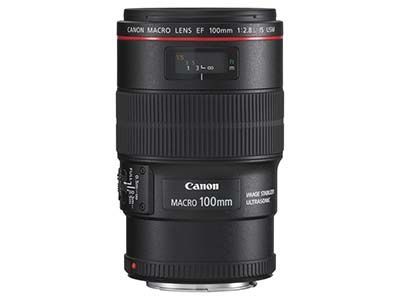
Canon EF 100mm f/2.8L Macro IS USM
Specs
- Focal length: 100 mm (equivalent to 160 mm on APS-C format)
- Angle of view: 24°
- Aperture: f/2.8 to f/32
- Minimum focusing distance: 30 cm
- Maximum magnification: 1x (1:1)
- Weight and dimensions: 625 g, 77.7 x 123 mm
- Compatibility: Canon EF mount (Full Frame and APS-C)
Analysis
Here, Canon raised the bar. They took the best of the classic 100mm and refined it with their “L” series: better build quality, sharper and more contrasty optics, hybrid stabilization (very effective at close distances), and weather sealing.
This has been Canon’s most widely used professional macro lens for over a decade. It’s ideal for nature macro, professional product photography, artwork reproduction, and even outdoor portraits where the stabilizer helps with handheld shooting.
The working distance is perfect for insects or delicate scenes, and its sharpness and color rendering are among the best in its class. Though designed for DSLRs, it works flawlessly with RF mirrorless cameras via adapter (you can check EF-RF adapter prices on Amazon via this link).
It has no major downsides. If anything, its price was higher than other options at launch, but today it can be found second-hand at reasonable prices. It’s the most balanced full-frame option if you’re not switching to the newer RF version.
Ideal use: All types of professional macro, portrait, hybrid use.
Limited use: None, unless you’re seeking something ultra-specialized.
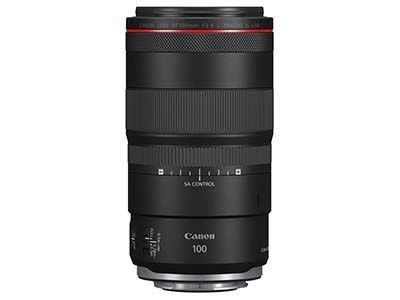
Canon RF 100mm f/2.8L Macro IS USM
Specs
- Focal length: 100 mm (equivalent to 160 mm on APS-C format)
- Angle of view: 24°
- Aperture: f/2.8 to f/32
- Minimum focusing distance: 26 cm
- Maximum magnification: 1.4x
- Weight and dimensions: 730 g, 81.5 x 148 mm
- Compatibility: Canon RF mount (Full Frame and APS-C)
Analysis
This lens represents the natural evolution of its predecessor. Canon introduced real improvements, not just tweaks:
- Maximum magnification of 1.4x, surpassing 1:1 without needing extension tubes or additional lenses.
- New floating focus system, which improves sharpness at close distances.
- Control of “spherical aberration” via a ring (similar to a “soft focus” effect for portraits).
- Upgraded hybrid IS and overall color and contrast performance.
All of this surely makes it the best Canon macro lens of all time, and one of the best in its focal range on the market. It’s extremely sharp at all distances and very versatile. It’s suitable for both 1:1 macro and portrait with an ethereal look, or even for enlarged detail photography without accessories.
The only “but” is the price: pricier than its predecessors and rather bulky. Also, some users find the aberration ring somewhat unnecessary or easy to bump accidentally. But in terms of pure performance, it’s at the highest level.e aberración algo innecesario o fácil de mover por error.
Ideal use: Professional macro, artistic portrait, stacking, nature.
Limited use: Few, except budget or size.
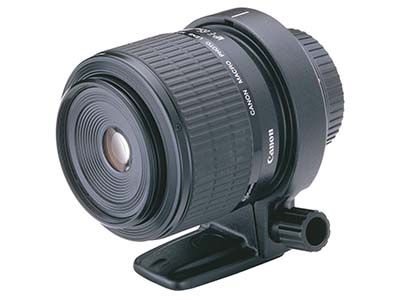
Canon MP-E 65mm f/2.8 1–5x Macro
Specs
- Focal length: 65 mm (equivalent to 104 mm in APS-C format)
- Angle of view: 18.6°
- Aperture: f/2.8 to f/16
- Minimum focusing distance: 24 cm
- Maximum magnification: 5x (5:1)
- Weight and dimensions: 710 g, 81 x 98 mm
- Compatibility: Canon EF mount (Full Frame and APS-C)
Analysis
This lens is a special case within Canon’s lineup, and possibly one of the most specialized lenses ever designed. It does not focus to infinity: it’s made exclusively for extreme macro, from 1x to 5x.
If your goal is to photograph small insects, organic structures, or textures invisible to the naked eye, it’s irreplaceable (otherwise you’d have to adapt microscope lenses). But it requires technique: manual focus only, with minimal tolerance margin, and it absolutely demands the use of a tripod, micrometric rail, and external lighting (flash, LED, etc.).
It’s not for everyone, and outside extreme macro it has little use. But for those dedicated to this type of photography (science, taxonomy, technique), it’s an extraordinary tool. There are some third-party alternatives today, but none with this native compatibility.
Ideal use: Extreme macro (1.5x to 5x), stacking, entomology.
Limited use: Everything else.
Third-party brands: Full Frame lenses
Canon, especially in its DSLR ecosystem (EF mount), has long relied on strong support from brands like Sigma, Tamron, Tokina, Laowa, Irix, Samyang, Meike, and 7Artisans. These lenses, often more affordable or specialized than native Canon lenses, offer very valuable alternatives for macro photography. Let’s go by focal length order, highlighting strengths and weaknesses.
Short-to-mid focal length (90-105mm): the favorite for classic macro
This is the most balanced and demanded focal range for macro photography, as it offers a comfortable working distance and good versatility beyond the macro field.
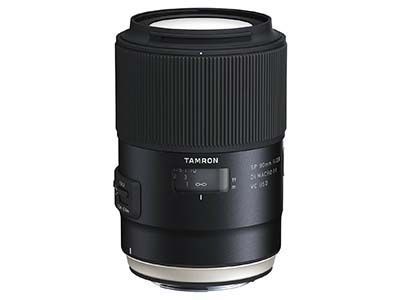
Tamron SP 90mm f/2.8 Di Macro
Specs
- Focal length: 90 mm (equivalent to 144 mm in APS-C format)
- Angle of view: 27°
- Aperture: f/2.8 to f/32
- Minimum focusing distance: 30 cm
- Maximum magnification: 1x (1:1)
- Weight and dimensions: 610 g, 79 x 117.1 mm
- Compatibility: Canon EF mount (Full Frame and APS-C)
Analysis
This is one of the classics of versatile macro photography. Tamron has refined its 90mm several times over the years, and this latest version with stabilization (VC) and ultrasonic motor (USD) is probably the most balanced.
The lens offers very good sharpness from f/2.8, reasonably fast autofocus, and effective stabilization—even at short distances—which is very helpful for handheld shooting. Its focal length, close to the ideal 100mm, makes it comfortable for nature photography, insects, or flowers without needing to get too close.
The bokeh is smooth, allowing it to double as a short telephoto for portraits. Optical quality is solid, with good contrast and aberration control in most situations. It’s not as surgically precise as manual Laowa or APO lenses, but it performs very well.
Ideal use: Nature macro, occasional portraiture, mixed field photography.
Limited use: Super macro, stacking, high-end technical studio work.
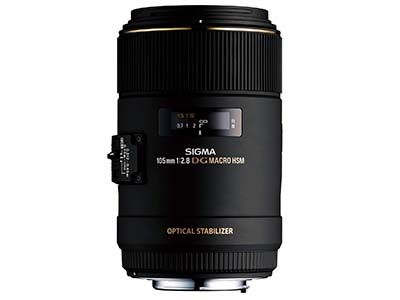
Sigma 105mm f/2.8 EX DG OS HSM
Specs
- Focal length: 105 mm (equivalent to 168 mm on APS-C format)
- Angle of view: 23.3°
- Aperture: f/2.8 to f/22
- Minimum focusing distance: 31.2 cm
- Maximum magnification: 1x (1:1)
- Weight and dimensions: 725 g, 78.3 x 126.4 mm
- Compatibility: Canon EF mount (Full Frame and APS-C)
Analysis
Sigma made a strong entrance into the versatile macro segment with this stabilized 105mm featuring an HSM motor. It’s very similar in concept to the Tamron 90mm, but with a slight advantage: it has a bit more focal length, giving you more room to work with skittish subjects.
The optical quality is very good, with solid central sharpness and pleasing background blur. The stabilizer is effective and especially noticeable when shooting handheld in natural light. The HSM motor allows for quiet and reasonably accurate focusing, though it can sometimes hesitate and “hunt” in low contrast or low light situations.
Like the Tamron, it’s not an extreme performer: it reaches 1:1 and that’s it. It’s not the best choice for super macro or precise stacking. It also doesn’t carry the “Art” badge or the premium build of newer Sigma lenses, though it’s still robust.
Newer versions of this lens exist for Sony and L-mount, but not for Canon.
Ideal use: Outdoor macro, full-frame portraiture, detail photography.
Limited use: Technical work, magnifications above 1:1, precision shooting with flash and rail.
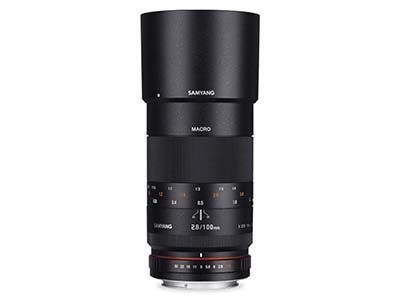
Samyang 100mm f/2.8 ED UMC Macro
Specs
- Focal length: 100 mm (equivalent to 160 mm on APS-C format)
- Angle of view: 24.8°
- Aperture: f/2.8 to f/32
- Minimum focusing distance: 30.7 cm
- Maximum magnification: 1x (1:1)
- Weight and dimensions: 730 g, 72.5 x 123.1 mm
- Compatibility: Canon EF mount (Full Frame and APS-C)
Analysis
Samyang offers here a more affordable alternative to the Laowa 100mm, with some trade-offs. It is also a fully manual lens, with no stabilization or autofocus, but its optical performance is more than decent. It delivers 1:1 magnification, good center sharpness, and a fairly attractive bokeh.
It doesn’t match the Laowa in chromatic correction or precision, and can show some edge softness at wide apertures. However, its price is usually very competitive, making it a great entry point for those who want to experiment with serious macro photography without breaking the bank.
Ideal use: Static macro, manual focus practice, object photography.
Limited use: Fast-moving nature, advanced stacking, high-demand optical or high-contrast situations.
Long reach

Irix 150mm f/2.8 Macro 1:1 Dragonfly
Specs
- Focal length: 150 mm (equivalent to 240 mm on APS-C format)
- Angle of view: 16°
- Aperture: f/2.8 to f/32
- Minimum focusing distance: 34 cm
- Maximum magnification: 1x (1:1)
- Weight and dimensions: 840 g, 87 x 135 mm
- Compatibility: Canon EF mount (Full Frame and APS-C)
Analysis
This is one of the most interesting long-reach macro lenses available in Canon EF mount. Fully manual, with a minimum focusing distance of about 34 cm, it allows comfortable work with insects, arachnids, or delicate scenes without getting too close. Optical quality is very good, with excellent sharpness from f/4 and high contrast, even at maximum aperture.
The Dragonfly design combines robustness (metal body, sealed against dust and moisture) with features designed for demanding macro work, such as a wide, smooth focus ring and an integrated tripod mount. It has no stabilizer, so it requires some skill for handheld shooting, but its balance and ergonomics help.
Ideal use: insects, delicate scenes, field macro with good technique.
Limited use: spontaneous or fast photography without support.
Other focal lengths and creative proposals: Extreme macro (beyond 1:1)
Laowa offers a series of lenses designed for advanced macro photography that go beyond the classic 1:1 and reach magnifications up to 2:1 or even 5:1. It also includes creative proposals such as wide-angle lenses with macro capability or probe-type systems intended for video and specialized photography. These lenses are aimed at users with very specific needs: controlled environments, static subjects, flash work, or precise composition with perspective control.
Not all of these lenses are available in all Canon mount versions. Some models exist only for Canon EF (for DSLRs), while others are available in Canon RF version (for mirrorless cameras). In all cases, Canon RF users can use EF lenses with an EF-RF adapter.
| Laowa Lens | Canon EF | Canon RF | Canon EF-M |
|---|---|---|---|
| Laowa 25mm f/2.8 2.5–5× Ultra Macro | ✔️ | ❌ (adapter) | ❌ |
| Laowa 58mm f/2.8 2× Ultra Macro APO | ❌ | ✔️ | ❌ |
| Laowa 60mm f/2.8 2× Ultra Macro | ✔️ | ❌ (adapter) | ❌ |
| Laowa 85mm f/5.6 2× Ultra Macro APO | ❌ | ✔️ | ❌ |
| Laowa 90mm f/2.8 2× Ultra Macro APO | ❌ | ✔️ | ❌ |
| Laowa 100mm f/2.8 2× Ultra Macro APO | ✔️ | ✔️ | ❌ |
| Laowa 15mm f/4 Wide Angle Macro 1:1 | ✔️ | ❌ (adapter) | ❌ |
| Laowa 15mm f/4 Wide Angle Macro Shift | ✔️ | ❌ (adapter) | ❌ |
| Laowa 24mm f/14 2× Macro Probe | ✔️ | ✔️ | ❌ |
| Laowa 24mm T14 PeriProbe | ✔️ | ✔️ | ❌ |
| Laowa 25mm Tilt-Shift Macro | ✔️ (Cine/EF) | ❌ (adapter) | ❌ |
| Laowa 100mm Tilt-Shift Macro | ✔️ (limited ed.) | ❌ (adapter) | ❌ |
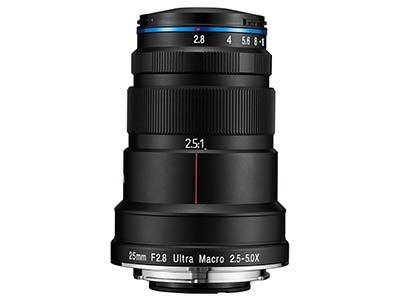
Laowa 25mm f/2.8 2.5–5× Ultra Macro
Specs
- Focal length: 25 mm (equivalent to 40 mm on Canon APS-C)
- Field of view: 10.3°
- Aperture: f/2.8 to f/16
- Minimum focusing distance: 17.3 cm (at 2.5x)
- Maximum magnification: 5:1
- Weight and dimensions: 400 g, 65 × 82 mm
- Compatibility: Canon EF (Full Frame and APS-C)
- Focus: Manual
- Stabilization: No
Analysis
This lens is a specialized tool, designed exclusively for super macro photography. It’s not a general-purpose macro: its magnification range goes from 2.5x to 5x, which means it cannot focus to infinity or cover lower magnifications. This makes it a lens aimed at advanced users or technicians looking to explore tiny structures: small insects, textures, electronic components, minerals, etc.
Unlike conventional macro lenses, the Laowa 25mm requires working very close to the subject, which limits its use with moving subjects. Additionally, at these magnification levels, depth of field is extremely shallow and lighting is scarce, so using a tripod, focusing rail, and controlled artificial lighting is essential.
Optically, the lens delivers excellent sharpness in the center at mid-apertures, though it may show some vignetting or softness at the edges when wide open. Distortion is minimal and contrast is high, which is notable for such an extreme optical design.
It’s not a lens for everyone, but within the super macro niche, it’s a standout for its price-performance ratio, image quality, and portability. Lightweight, solid, and free of electronic components that might complicate use with mirrorless bodies.
Ideal use: Technical super macro, photography of small insects, minerals, components, advanced stacking.
Limited use: General macro, portraiture, unprepared live subjects, or outdoor work without support equipment.
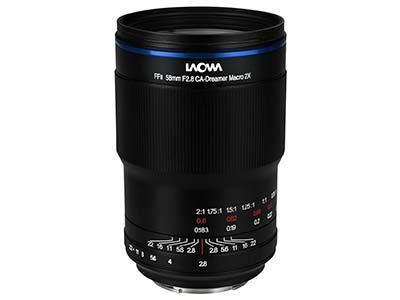
Laowa 58mm f/2.8 2× Ultra Macro APO
Specs
- Focal length: 58 mm (equivalent to 93 mm on Canon APS-C)
- Field of view: 40.9°
- Aperture: f/2.8 to f/22
- Minimum focusing distance: 18.5 cm
- Maximum magnification: 2:1
- Weight and dimensions: 335 g, 74 × 90.5 mm
- Compatibility: Canon RF (Full Frame and APS-C)
- Focus: Manual
- Stabilization: No
Analysis
This lens stands out for its excellent optical performance and apochromatic (APO) design, which minimizes chromatic aberrations both in focus and out of focus. It delivers 2:1 magnification without additional accessories, making it a powerful option for advanced macro work, especially on APS-C where the narrower angle is ideal for small subjects.
Lightweight and compact, it’s very easy to handle in the field, and its f/2.8 aperture also makes it suitable for tight portraits or detail shots with a blurred background. The focus ring is smooth and precise, ideal for fine manual work.
Ideal use: Extreme detail, product photography, textures, flowers, mixed macro.
Limited use: Fast-paced photography or subjects requiring AF.
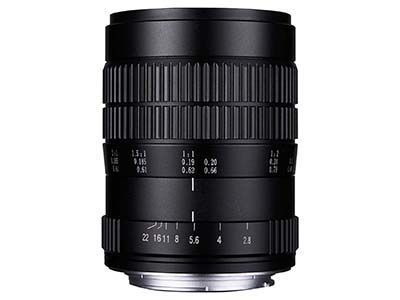
Laowa 60mm f/2.8 2× Ultra Macro
Specs
- Focal length: 60 mm (equivalent to 96 mm on Canon APS-C)
- Field of view: 25.3°
- Aperture: f/2.8 to f/22
- Minimum focusing distance: 18.5 cm
- Maximum magnification: 2:1
- Weight and dimensions: 503 g, 70 × 95 mm
- Compatibility: Canon EF (Full Frame and APS-C)
- Focus: Manual
- Stabilization: No
Analysis
The Laowa 60mm f/2.8 2× Ultra Macro was one of the first to offer 2:1 magnification with full-frame coverage without the need for extension tubes or additional lenses, making it a highly attractive choice for demanding macro photographers. On APS-C cameras, its effective focal length makes it ideal for shooting insects, small objects, or textures with good background separation.
Optical performance is very solid from f/4, with good contrast and center sharpness, although some edge softness appears at maximum aperture. It lacks internal focusing, so the barrel extends visibly during focusing, which can be inconvenient in tight spaces or with sensitive subjects.
Although heavier than more recent Laowa models, its versatility and reproduction capabilities make it a very useful tool for those who prioritize true macro performance over automation or ultra-compact design.
Ideal use: Advanced macro photography, insects, product, textures.
Limited use: Tight spaces, subjects disturbed by barrel movement.
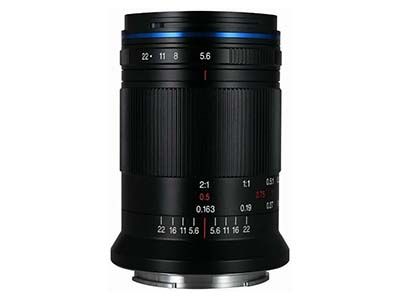
Laowa 85mm f/5.6 2× Ultra Macro APO
Specs
- Focal length: 85 mm (equivalent to 136 mm on Canon APS-C)
- Field of view: 28.55°
- Aperture: f/5.6 to f/22
- Minimum focusing distance: 16.3 cm
- Maximum magnification: 2:1
- Weight and dimensions: 259 g, 53 × 81 mm
- Compatibility: Canon RF (Full Frame and APS-C)
- Focus: Manual
- Stabilization: No
Analysis
This 85mm is currently the smallest and lightest 2:1 macro lens available. It’s specifically designed for field photography and travel, where weight matters as much as performance. Despite its modest f/5.6 aperture, it performs very well optically from wide open, with excellent chromatic correction thanks to its APO (apochromatic) design.
Its minimum focusing distance allows for extreme close-ups, and the focal length provides a well-balanced compromise between working distance and background compression, making it easier to photograph insects without getting too close. The build is all metal, with good handling and mechanical precision.
It’s ideal for those seeking an advanced macro solution without bulk or sacrificing image quality.
Ideal use: Field macro, lightweight travel photography, nature on the go.
Limited use: Low light conditions, extreme bokeh work, or creative portraits.
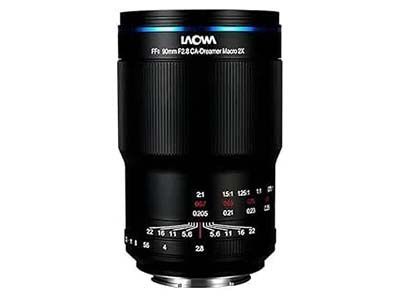
Laowa 90mm f/2.8 2× Ultra Macro APO
Specs
- Focal length: 90 mm (equivalent to 144 mm on Canon APS-C)
- Field of view: 27°
- Aperture: f/2.8 to f/22
- Minimum focusing distance: 20.5 cm
- Maximum magnification: 2:1
- Weight and dimensions: 619 g, 74 × 120 mm
- Compatibility: Canon RF (Full Frame and APS-C)
- Focus: Manual
- Stabilization: No
Analysis
The 90mm f/2.8 2× APO is one of the most well-balanced lenses in Laowa’s extreme macro lineup. It offers a comfortable working distance for insect and nature detail photography, while maintaining a robust build and high-level optical design.
Its 2:1 reproduction ratio puts it above many traditional macro lenses, and the f/2.8 aperture makes it useful for creative portraits or scenes requiring more depth-of-field control. Chromatic correction is excellent, even in out-of-focus areas, and center sharpness is impressive from wide open.
It’s a very solid choice for those who want demanding macro performance with greater creative potential and a user experience close to that of a professional lens.
Ideal use: Technical and creative macro, insects, detailed portraits.
Limited use: Fast-paced shooting without support, continuous focusing on moving subjects.
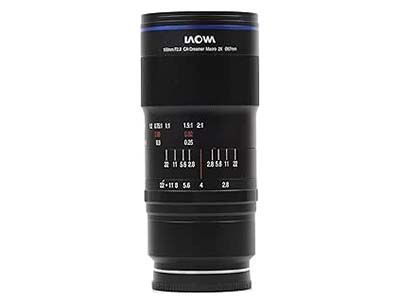
Laowa 100mm f/2.8 2× Ultra Macro APO
Specs
- Focal length: 100 mm (equivalent to 160 mm on Canon APS-C)
- Field of view: 24.4°
- Aperture: f/2.8 to f/22
- Minimum focusing distance: 24.7 cm
- Maximum magnification: 2:1
- Weight and dimensions: 638 g, 72 × 125 mm
- Compatibility: Canon RF (Full Frame and APS-C)
- Focus: Manual
- Stabilization: No
Analysis
This version of Laowa’s 100mm f/2.8 is a direct evolution of the classic 1:1 model, and one of the most complete lenses in the brand’s macro lineup. It offers 2:1 magnification without any additional accessories, enabling exceptional detail when photographing tiny subjects or fine textures.
The APO (apochromatic) design minimizes chromatic aberrations even under demanding conditions or with defocused backgrounds. Its 100 mm focal length provides a comfortable working distance—great for insects, nature, and product photography—and the f/2.8 aperture also makes it useful for portraits, though focusing will be more delicate.
Optical quality is excellent across the frame from mid apertures, and while it has moderate weight, the build is solid, all-metal, and well-finished. Manual focus might be a barrier for some users, but the ring is smooth and precise, making it well-suited to controlled setups or tripod use.
Ideal use: Advanced macro, focus stacking, field photography, product, detailed portraiture.
Limited use: Spontaneous or fast shooting without support, dynamic focusing on moving subjects.
Other focal lengths and creative concepts: Macro with a creative perspective
Lenses that provide a different point of view: wide-angle, periscopic, or with plane shift.
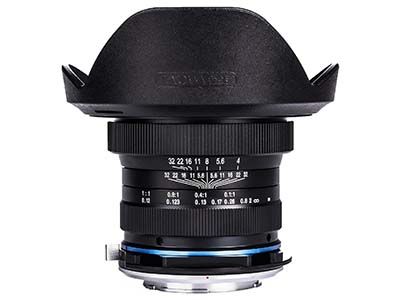
Laowa 15mm f/4 Wide Angle Macro 1:1
Specs
- Focal length: 15 mm (equivalent to 24 mm on Canon APS-C)
- Angle of view: 110°
- Aperture: f/4 to f/32
- Minimum focusing distance: 12.2 cm
- Maximum magnification: 1:1
- Weight and dimensions: 410 g, 84 × 64 mm
- Compatibility: Canon RF mount (Full Frame and APS-C)
- Focus: Manual
- Stabilization: No
Analysis
This is one of the most unique macro lenses on the market: an ultra wide-angle optic with 1:1 magnification. This allows both the macro subject and its surroundings to be included in the composition—something rarely seen in this type of photography. Ideal for insects in their habitat, creative scenes, or controlled environments where context is as important as detail.
It has some natural geometric distortion due to the extreme focal length, though it’s well controlled, and it’s not easy to use: it requires very precise focusing and framing, especially because of the short working distance (the front element sits just millimeters from the subject). The focus ring is smooth and accurate, but demands proper technique.
Ideal use: Environmental macro, creativity, nature with context, extreme landscapes.
Limited use: Highly mobile insects, traditional studio or technical work.
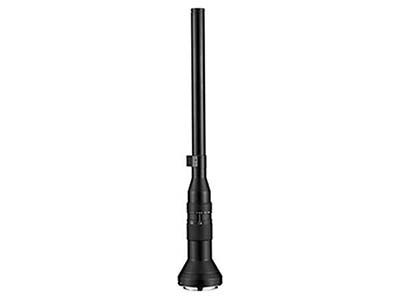
Laowa 24mm T14 Probe
Especificaciones
- Focal length: 24 mm (equivalent to 36 mm on Canon APS-C)
- Angle of view: 85°
- Aperture: f/14 to f/40
- Minimum focusing distance: 2 cm
- Maximum magnification: 2:1
- Weight and dimensions: 474 g, 38 × 408 mm
- Compatibility: Canon (Full Frame and APS-C)
- Focusing: Manual
- Stabilization: No
- Extras: Built-in front LED light
Análisis
This lens has redefined extreme macro photography. Its probe-like design allows you to capture images in otherwise inaccessible places: inside objects, food, plants, insects in nests, and more. The optics offer 2:1 magnification and great depth of field for its focal length, although the minimum aperture of f/14 limits usage without artificial lighting.
It includes a built-in LED light at the tip, useful for illuminating tight spaces. It requires solid technique, external support, and is usually used with a slider or tripod. It’s not versatile or lightweight, but it’s irreplaceable when you need that specific point of view.
Ideal use: creative photography, nature documentaries, video, product and food photography.
Limited use: spontaneous macro, handheld or unplanned photography.
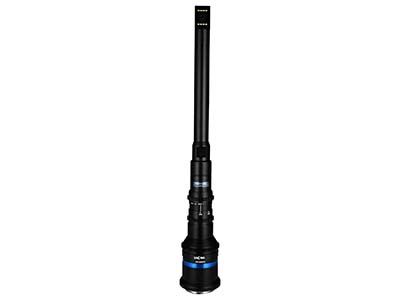
Laowa 24mm T14 PeriProbe
Specs
- Focal length: 24 mm (equivalent to 38 mm on Canon APS-C)
- Angle of view: 85° (with perpendicular angular view)
- Aperture: T14 to T40
- Minimum focusing distance: 2 cm
- Maximum magnification: 2:1
- Weight and dimensions: 770 g, 38 × 408 mm (interchangeable probe)
- Compatibility: Canon EF mount (Full Frame and APS-C)
- Focus: Manual
- Stabilization: No
- Extras: Built-in LED light, interchangeable tube with 90° angled lens
Analysis
Evolved version of the classic Probe. It features a 90° angled periscope lens, ideal for capturing low-angle horizontal shots or working in tight spaces. The rotating design allows for 360° composition without moving the camera body, making it a powerful tool for video and experimental photography.
Optical quality is similar to the standard model, with deep depth of field, 2:1 magnification, and good aberration control. It requires technique and support equipment, but offers unique creative possibilities.
Ideal use: Video production, creative product photography, impossible angles.
Limited use: General or fast-paced photography.
Canon APS-C: native macro lenses (EF-S and EF-M)
Shortlist: Which Canon APS-C macro lens to choose based on your profile
For those starting in macro and valuing versatility, the Canon EF-S 60mm f/2.8 Macro USM is one of the best native options for APS-C. Lightweight, compact, and with true 1:1 magnification, it allows close approach to the subject without additional accessories. Its effective focal length, equivalent to 96mm on full frame, is comfortable for portraits, and its f/2.8 aperture provides nice background blur. The USM focus is fast and quiet, ideal for static subjects or moderate movement. Its design without stabilization is well compensated by using a tripod or cameras with in-body stabilization (if mounted on mirrorless). Note: The lack of stabilization makes it less suitable for handheld shots, especially in low light or at maximum magnification.
For advanced photographers who make macro an important part of their work, the Canon RF 100mm f/2.8L Macro IS USM is fully compatible with APS-C bodies and one of the most complete options in the Canon ecosystem. Although designed for full frame, on APS-C it offers a narrower field of view (equivalent to 160mm), suitable for sensitive subjects like insects. Its hybrid stabilizer compensates for both angular and shift movements, and its sealed construction and L-series optical quality place it at a professional level. On APS-C mirrorless bodies with adapter, it retains all functionality.
Note: Its size and weight may be excessive for users seeking a lightweight and discreet solution in APS-C format.
For professionals seeking extreme macro or scientific photography, the Canon MP-E 65mm f/2.8 1-5x Macro is also fully compatible with APS-C via EF mount. In fact, the crop factor can even help fill the frame more with tiny subjects. This lens offers 1x to 5x magnification without accessories, but requires manual focus, tripod, and meticulous light control. It is a niche tool, ideal for scientists, naturalists, or experienced artistic photographers looking to explore the invisible.
Note: Extremely specialized use, steep learning curve, and unusable for normal focus or general scenes.
For budget-conscious photographers using full frame cameras, the Canon EF 50mm f/2.5 Compact Macro remains a valid alternative, though more limited. Compatible with EF-S bodies without adapters, it offers 1:2 magnification and decent optical quality at a very affordable price. Its compact design makes it easy to carry, ideal for students, hobbyists, or those who want to experiment without a big investment. Note: Does not offer 1:1 magnification, lacks stabilization, and its construction is not as refined as more modern optics.
▌Our choice: The Canon RF 100mm f/2.8L Macro IS USM is the top option to consider for those looking for a macro lens in the Canon system, including APS-C, though the equivalent focal length may feel a bit long for some users. It offers 1:1 magnification with a comfortable working distance and hybrid stabilization, making it ideal for handheld shooting. It stands out for its high optical quality, good aberration control, and fast, silent autofocus. Its robust build makes it reliable for professional use in macro and product photography.
Canon developed two specific mounts for cameras with APS-C sensors: EF-S for its digital SLRs, and EF-M for its EOS M mirrorless system. While both support macro photography, they follow quite different usage philosophies.
EF-S: More serious optics focused on technical results
The EF-S mount is designed for APS-C DSLR cameras, such as the EOS 80D, 90D, or 700D. Macro lenses made for this system tend to offer an experience closer to “classic” macro photography:
- Longer focal lengths (like 60mm, equivalent to around 96mm on full frame), allowing for more working distance from the subject.
- Fast and precise internal focusing, ideal for working with insects, flowers, or natural details without disturbing the subject.
- More solid construction, suitable for field work or extended use.
- Higher-quality optics, well-corrected for aberrations and sharp across the entire frame.
This system is especially recommended for those who do nature macro photography, portraiture with background blur, or even focus stacking, thanks to the increased distance between camera and subject.
EF-M: compactness and urban or creative use
The EF-M mount was designed for very compact mirrorless cameras like the EOS M50 or M6. Here, the philosophy clearly shifts:
- Small, lightweight lenses meant to be carried everywhere.
- Shorter focal lengths, like 28mm (equivalent to 45mm), requiring you to get very close to the subject.
- Creative electronic aids, such as built-in LED lighting or optical stabilization.
- Silent STM autofocus, also suitable for video or social media content.
EF-M macro lenses prioritize creative versatility over technical precision, making it easy and quick to photograph everyday objects, decorative details, food, makeup, or textures.
Regardless of the mount, using an APS-C sensor offers practical advantages in macro photography:
- Greater apparent magnification: due to the crop factor (1.6x), the subject fills more of the frame without needing to get closer.
- More depth of field at the same aperture and framing: making it easier to get sharp images without heavily relying on focus stacking.
- Lighter and more affordable gear, ideal for beginners or photographers who prioritize mobility.
In short: EF-S provides a more complete experience for traditional macro photography, while EF-M supports a more accessible, modern, and creative approach.
Comparative table of all macro lenses for APS-C
| Mount | Brand | Model | Macro | AF/Manual | Stabilization | Format |
|---|---|---|---|---|---|---|
| EF-M | Canon | EF‑M 28 mm f/3.5 Macro IS STM | 1.2:1 | STM AF | Yes (Hybrid IS) | APS‑C |
| EF-S | Canon | EF‑S 35 mm f/2.8 Macro IS STM | 1:1 | STM AF | Yes | APS‑C |
| EF-S | Canon | EF‑S 60 mm f/2.8 Macro USM | 1:1 | USM AF | No | APS‑C |
| EF-S / EF-M | Laowa | 65 mm f/2.8 2× Ultra Macro APO | 2:1 | Manual | No | APS‑C |
| EF-S / EF-M | 7Artisans | 60 mm f/2.8 Macro | 1:1 | Manual | No | APS‑C |
| EF-S / EF-M | Meike | 60 mm f/2.8 Macro | 1:1 | Manual | No | APS‑C |
| EF-S / EF-M | Meike | 85 mm f/2.8 Macro | 1:1 | Manual | No | APS‑C |
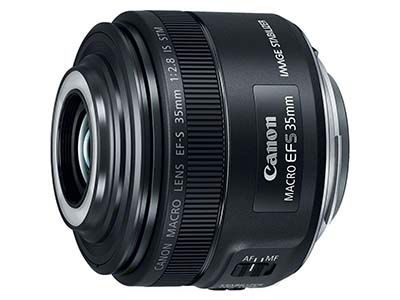
Canon EF-S 35mm f/2.8 Macro IS STM (with LED light)
Specs
- Focal length: 35 mm (equivalent to 56 mm on APS-C format)
- Angle of view: 63°
- Aperture: f/2.8 to f/32
- Minimum focusing distance: 13 cm
- Maximum magnification: 1x (1:1)
- Weight and dimensions: 190 g, 69.2 x 55.8 mm
- Compatibility: Canon EF-S mount
Analysis
This is one of the most unique macro lenses in Canon’s lineup. Designed for APS-C, it offers a 56mm equivalent focal length, with true 1:1 magnification and one unique feature: two small LED lights built into the sides of the lens front.
These lights are very useful for illuminating close subjects without casting harsh shadows, and they eliminate the need for external flashes or LED panels when shooting handheld. In small product photography, food, technical details, or even makeup, they can be a huge advantage.
On the downside, it has a very short working distance—just a few centimeters. This can be inconvenient or limiting when photographing insects, as the lens front almost touches the subject. It can also cause shadows or disturb the animal. It’s sharp and well-corrected, but not as versatile as longer macro lenses.
Ideal use: Small object detail, scientific photography, still life, controlled environments.
Limited use: Insects or subjects that require more working distance.
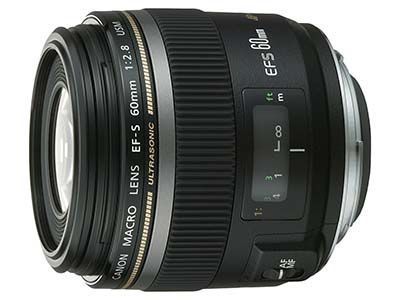
Canon EF-S 60mm f/2.8 Macro USM
Specs
- Focal length: 60 mm (equivalent to 96 mm on APS-C format)
- Angle of view: 25°
- Aperture: f/2.8 to f/32
- Minimum focusing distance: 20 cm
- Maximum magnification: 1x (1:1)
- Weight and dimensions: 335 g, 73 x 69.8 mm
- Compatibility: Canon EF-S mount (APS-C only)
Analysis
This was Canon’s first macro lens specifically designed for APS-C sensors, and it remains one of the most well-balanced in the system. Its effective focal length (≈96mm on full frame) places it in the ideal range for traditional macro photography, offering good working distance without needing to get too close to the subject.
Optically, it’s very solid: sharp even wide open, excellent contrast, and chromatic aberration and distortion correction above the average of its time. The internal focusing with USM motor makes it fast, quiet, and free of barrel extension, which is important in tight natural environments or when photographing wildlife.
Outside of macro work, its focal length and aperture also make it useful for portraiture: it delivers soft background blur and a comfortable shooting distance for close-ups with APS-C cameras. In that sense, it’s a highly versatile lens.
Ideal use: Nature, outdoor macro, APS-C portraiture.
Limited use: No stabilization (requires good technique or a tripod).
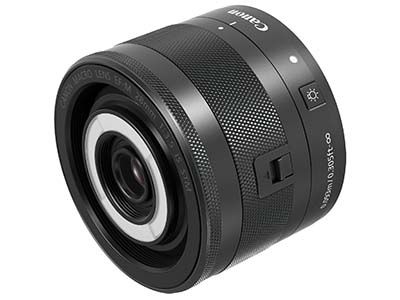
Canon EF-M 28mm f/3.5 Macro IS STM (with LED light)
Specs
- Focal length: 28 mm (equivalent to 45 mm on APS-C)
- Angle of view: 53°
- Aperture: f/3.5 to f/22
- Minimum focusing distance: 9.3 cm
- Maximum magnification: 1.2x (with Super Macro mode)
- Weight and dimensions: 130 g, 60.9 x 45.5 mm
- Compatibility: Canon EF-M mount (APS-C only, EOS M series)
Analysis
This is a smaller sibling of the EF-S 35mm, but it’s exclusive to mirrorless cameras with the EF-M mount (such as the M50 or M6). It shares many ideas with the 35mm, but even pushes some further:
- It offers 1.2x magnification (higher than the standard 1:1).
- It has a built-in dual front LED flash, controllable from the camera.
- It’s extremely compact and lightweight, ideal for everyday carry.
However, just like the 35mm, it has a very short working distance. At maximum magnification, you’re almost touching the subject. That makes it great for static objects, but not ideal for insects or moving subjects.
Still, it’s very practical for people doing product photography, food, cosmetic details, or textures. Also great for those who don’t want to carry bulky macro gear.
Ideal use: product, food, studio detail.
Limited use: wildlife, nature, portrait.
Third-party lenses: APS-C options
We divide the selection into two main groups:
1. Versatile autofocus lenses (Sigma, Tamron)
Although not specifically designed for APS-C sensors, lenses like the Tamron SP 90mm or Sigma 105mm macro are used very effectively on APS-C bodies with EF mounts. On this format, their equivalent focal length (135–150mm) is comfortable for traditional macro work. Since we’ve already discussed these lenses above, we won’t repeat that content here. Follow the links to see the analysis:
2. Specialized manual lenses (Laowa, Samyang, others)
Here, we find two major profiles. On one hand, brands like Laowa and Samyang offer lenses with excellent image quality, magnifications above 1:1, and robust, well-corrected designs—intended for advanced photographers who seek greater magnification and prefer, or don’t mind, shooting manually. We’ve also covered the Samyang already:
On the other hand, more budget-friendly brands like 7Artisans or Meike also offer manual lenses for APS-C. While attractive in terms of price, their optical and mechanical performance is usually below that of the above: better suited as entry points or for less demanding use.
Standard manual lenses
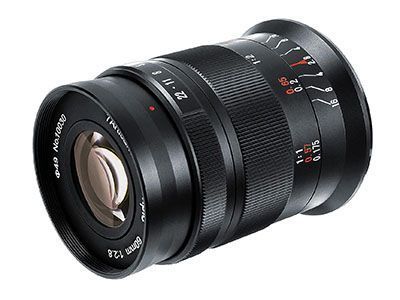
7Artisans 60mm f/2.8 Macro
Specs
- Focal length: 60 mm (equivalent to 96 mm on APS-C format)
- Field of view: Approximately 25°
- Aperture: f/2.8 to f/16
- Minimum focusing distance: 26 cm
- Maximum magnification: 1x (1:1)
- Weight and dimensions: 550 g, 60 x 100 mm
- Compatibility: Canon EF-M mount (APS-C only)
Analysis
Affordable manual lens offering 1:1 magnification, designed for beginners or photographers on a tight budget. Optical quality is decent, with acceptable sharpness but limited aberration correction and image uniformity. The build is simple and lightweight, lacking stabilization and a motor, which means a tripod and good lighting conditions are essential. Despite its limitations, it’s a valid option for learning macro or personal projects where extreme quality isn’t critical.
Ideal use: Getting started with macro, static subjects.
Limitations: Modest optical quality, no stabilization or autofocus, not intended for professional use.
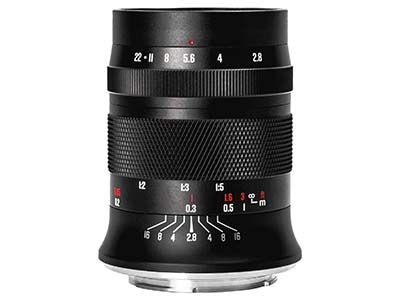
Meike 60mm f/2.8 Macro
Specs
- Focal length: 60 mm (equivalent to 96 mm on APS-C format)
- Field of view: Approximately 25°
- Aperture: f/2.8 to f/22
- Minimum focusing distance: 18 cm
- Maximum magnification: 1x (1:1)
- Weight and dimensions: 320 g, 65 x 90 mm
- Compatibility: Canon EF / EF-M mount (Full Frame, APS-C, and specific versions for APS-C mirrorless)
Analysis
Similar in features to the 7Artisans 60mm, this lens offers 1:1 magnification and manual focus at a low cost. Its optical performance is functional for non-demanding work, with acceptable sharpness but lacking in advanced refinements. The lack of stabilization and autofocus means it requires a tripod and good lighting. It’s a suitable option for beginners in macro or as a budget secondary lens.
Ideal use: Learning, static and experimental photography.
Limitations: Modest quality, no stabilization or autofocus, not for professional use.
Meike 85mm f/2.8 Macro
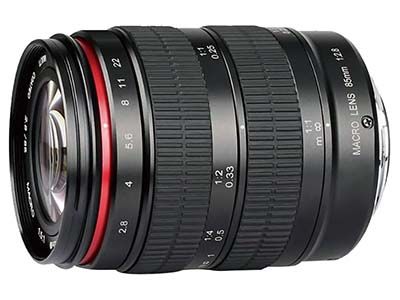
Specs
- Focal length: 85 mm (equivalent to 136 mm on APS-C format)
- Field of view: Approximately 28°
- Aperture: f/2.8 to f/22
- Minimum focusing distance: 25 cm
- Maximum magnification: 1x (1:1)
- Weight and dimensions: 500 g, 72 x 98 mm
- Compatibility: Canon EF mount (Full Frame and APS-C)
Analysis
A manual lens with 1:1 magnification that stands out for having a slightly longer working distance than the other member of the Meike family, making it easier to photograph more sensitive subjects. It offers good central sharpness and contrast, though edge performance could be improved. It lacks stabilization and autofocus, but its build quality is solid for its price range. Suitable for hobbyists looking for solid performance in classic macro without investing in more expensive options.
Ideal use: Amateur macro, small and static objects, studio work.
Limitations: No stabilization or autofocus, modest edge sharpness.
Extreme macro
Laowa 65mm f/2.8 2x Ultra Macro APO
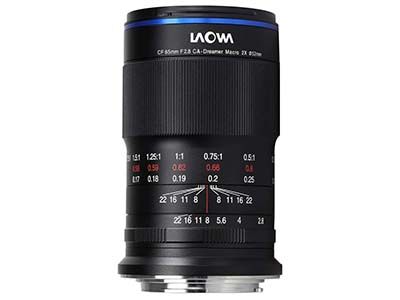
Specs
- Focal length: 65 mm (equivalent to 104 mm on APS-C format)
- Field of view: 24.4°
- Aperture: f/2.8 to f/22
- Minimum focusing distance: 17 cm
- Maximum magnification: 2x (2:1)
- Weight and dimensions: 335 g, 57 x 100 mm
- Compatibility: Canon EF-M / RF mount (APS-C only)
Analysis
This lens is a rare find in the world of APS-C macro photography, thanks to its 2:1 reproduction ratio—double that of classic 1:1 macro. Its apochromatic (APO) design significantly reduces chromatic aberration, delivering images with excellent sharpness and contrast. It lacks autofocus and stabilization, so it requires precise handling and preferably a tripod for best results. The short focal length combined with generous magnification makes it ideal for capturing extremely small details, especially in studio photography or focus stacking. For stacking, being a manual lens, patience is essential—as is a precision focus rail.
Ideal use: Extreme macro, focus stacking, studio, tiny detail photography.
Limitations: Manual focus, no stabilization, not suitable for fast action, outdoor use, or users seeking ease of use.
- As an Amazon Associate, this website earn from qualifying purchases.