

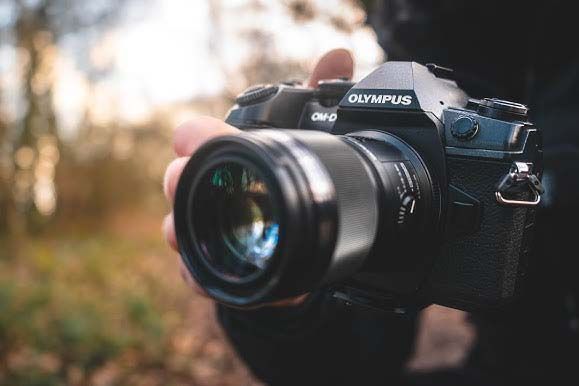
Macro photography allows you to capture details that escape the human eye: textures, shapes, and structures that we cannot see no matter how close we get. But to achieve this, we need a lens specifically designed to work at short distances.
Now, there are many options on the market, and not all are equally good or useful, so: what is the best macro lens for starting out? In this post, we will try to answer that question and outline the key points for choosing a reliable macro lens that can also be used for portraits, product shots, or nature photography.
Focal length matters (a lot)
One of the decisive factors in a macro lens is its focal length. For general use, the most recommended lenses fall within the 90 mm to 105 mm range (in full-frame format, see the table below for equivalents in other systems). Why? Because they provide the ideal working distance: you can get close enough to capture tiny details without having to be right up against your subject. This is not only more comfortable, but also prevents casting shadows or scaring small animals.
| Format | Crop factor | Focal length equivalent to 90–105 mm FF |
|---|---|---|
| APS-C (1.5×) | 1.5× | approx. 60–70 mm |
| APS-C (Canon) | 1.6× | approx. 56–66 mm |
| Micro 4/3 | 2.0× | approx. 45–52.5 mm |
Additionally, these focal lengths have an extra quality: they work very well for portrait photography. The compression they provide enhances facial features while allowing the subject to be isolated against a soft, blurred background. On the other hand, if we choose a shorter focal length like 50 mm or 60 mm (still speaking in full-frame terms), macro is possible, but only by getting almost on top of the subject to achieve maximum magnification, and the background will be more prominent, which is usually undesirable. That’s why, if we’re looking for an all-around macro lens, the 90–105 mm range is our starting point (though there are other options, as shown in the lens selection linked at the end of this article).
1:1 Magnification, Real Macro
Let’s not be fooled by labels: many lenses with the word “macro” printed on the barrel do not offer true macro capability. The serious standard is a 1:1 reproduction ratio, meaning the photographed object appears on the sensor at life size from the viewing distance. Of course, there’s nothing inherently wrong with shooting at lower magnifications, and a photographer might be more interested in close-up photography, where subjects appear in context, than in true macro. But if we want to appreciate the scales on a butterfly wing or the texture of a fabric in full detail, we’ll need that 1:1 magnification or higher.

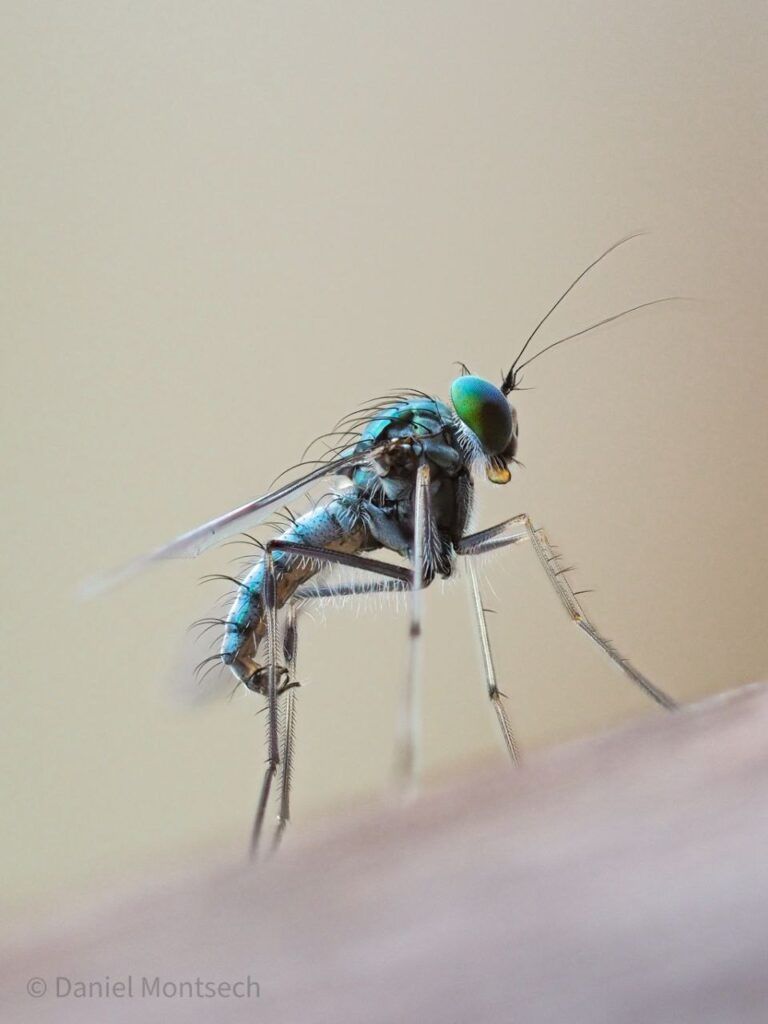
▌Left: Close-up photograph taken with a standard zoom and extension tubes; right: photograph with a macro lens of a much smaller insect, in an eight-photo focus stack.
Focus Limiter
One of the reasons some photographers get frustrated with macro lenses is their slow or erratic focusing. This is not a flaw, but a natural consequence of the wide focus range these lenses must cover: from just a few centimeters to infinity.
That’s why a good macro lens should have a focus range limiter. This feature allows you to restrict the area in which the lens searches for focus (for example, only between 30 and 50 cm, or only from 50 cm to infinity). The result: faster and more precise focusing, both for macro as well as for portrait or product photography. Without this limiter, the AF may “hunt” for a focus point longer than desired.

▌Dial of a Zuiko 60 mm f/2.8. It can be set from 0.19 m to infinity (full focus range) to be ready for any situation; or from 0.19–0.4 m and 0.4 m to infinity. Here, you just need to remember to set the dial correctly, or the lens will never find the subject and will keep hunting.
Types of Autofocus
Not all autofocus motors are the same. Each type has its own characteristics in terms of speed, accuracy, and noise, and these features significantly affect how we work.
| Type of Motor | Main Features |
|---|---|
| Ultrasonic Motor (USM, SWM, HSM, etc.) | Fast, silent, and precise focusing. Ideal for portraits and nature. |
| Stepper Motor (STM, PZD, etc.) | Smoother and quieter movement, suitable for video and fine macro focusing. |
| Linear Motor (LM, XD, VCM, etc.) | Extremely fast and precise, excellent for tracking small subjects. |
| DC or Traditional Micromotor | Noisier and slower. Common in older or budget models. |
Here is a table showing the type of motor used by reference lenses for the main mounts:
| Macro Lens | System / Mount | Focus Motor |
|---|---|---|
| Canon EF 100mm f/2.8L Macro IS USM | Canon EF (Full Frame) | USM (ultrasonic) |
| Canon RF 100mm f/2.8L Macro IS USM | Canon RF (Mirrorless) | Dual Nano USM (hybrid ultrasonic) |
| Nikon AF-S 105mm f/2.8G VR Micro | Nikon F (Full Frame) | SWM (Silent Wave Motor – ultrasonic) |
| Nikon Z MC 105mm f/2.8 VR S | Nikon Z (Mirrorless) | STM (stepper) |
| Sony FE 90mm f/2.8 Macro G OSS | Sony E (Full Frame) | DDSSM (piezo ultrasonic motor) |
| Fujifilm XF 80mm f/2.8 R LM OIS WR Macro | Fujifilm X (APS-C) | LM (linear motor) |
| Olympus M.Zuiko 60mm f/2.8 Macro | Micro 4/3 | MSC (Movie & Still Compatible – stepper type) |
| Panasonic Leica 45mm f/2.8 Macro-Elmarit | Micro 4/3 | Stepper AF (very quiet) |
| Tokina ATX-i 100mm f/2.8 Macro | Canon EF / Nikon F | DC micromotor |
| Sigma 105mm f/2.8 DG DN Macro Art | Sony E / L-Mount | HSM (ultrasonic) |
Optical Stabilization
Macro photography is an extremely movement-sensitive discipline, because when working with high magnifications, even the slightest shake becomes noticeable. That’s why, even though a tripod often remains an essential tool, having optical stabilization (OIS or VR) in the lens can make a difference when shooting handheld.
If our camera has in-body stabilization (IBIS), this compensates. But if it doesn’t, a stabilized lens will provide greater flexibility, even in general situations, such as low-light portraits or nature shots at sunrise.
f/2.8 Aperture: Light and Bokeh in Balance
Although in macro photography small apertures (f/8, f/11, or even f/16) are often used to gain depth of field, having an f/2.8 aperture provides exactly what we mentioned at the beginning: versatility.
With f/2.8, we can create portraits with soft bokeh and play with ambient light without needing to raise the ISO too much (though technological developments make this less of an issue on modern cameras). Additionally, in wider shots or uses outside macro, this aperture allows easier subject isolation. In short: an ultra-bright macro lens is not required. F/2.8 is the sweet spot between performance, weight, and usability.
Optical Quality
Almost all modern macro lenses are sharp. The real difference lies in contrast, aberration correction, and performance in real-world situations: harsh light, complex backgrounds, or variable weather conditions.
In macro, one type of optical defect that becomes particularly problematic is chromatic aberration. This occurs when the lens fails to focus all colors of light at the same point, producing edges with purple, green, or blue tints around high-contrast contours. In practice, it can ruin very fine details, which is undesirable in any type of photography, but especially in macro.
The problem is amplified in macro photography for two reasons:
- The distance to the subject is very short, which amplifies optical imperfections.
- The contrast between close planes and blurred backgrounds can be extreme, which worsens colored edges if the lens is not well corrected.
That’s why it’s important to choose a macro lens with high-quality optics, using special elements such as ED (Extra-low Dispersion) or apochromatic lenses to control these aberrations.


▌Notice the blue line along the edge of the wing in this image taken with a standard zoom and extension tubes. It’s not an extreme case and the photo is fully usable, but in details like this lies the difference between good and excellent.
Construction and Ergonomics
Unlike other genres practiced in more controlled environments, macro photography often takes us to places that demand a lot from our equipment: damp gardens, dusty paths, smoke, buzzing insects… That’s why lens build quality is a practical necessity.
A good macro lens should have dust and moisture sealing. This protection not only extends the lifespan of our equipment (lens and camera—don’t forget the latter), but also allows us to work more relaxed without worrying about the conditions we encounter. Similarly, the body should be robust and well-assembled, with tight tolerances and a solid feel to the touch.
Finally, and no less important, is the manual focus ring. While autofocus is useful, many macro photographers prefer to make fine adjustments manually to achieve surgical sharpness at the desired point (for example, an insect’s eye or a flower’s stamen). A wide, smooth ring with good travel and precise response is essential for working with that level of control, especially when using techniques like focus stacking.
In Summary: One Macro for Everything
A macro lens doesn’t have to be limited to a single discipline. Well chosen, it can be one of the most useful and versatile lenses in our kit. The combination of a 90–105 mm focal length, true 1:1 reproduction, autofocus with limiter, stabilization, optical quality, and sturdy construction gives us access to the world of the tiny while still covering our needs (or at least part of them) in portrait, nature, product, and even video.
Learn more:
- As an Amazon Associate, this website earn from qualifying purchases.