


Among all the photography accessories you can carry in your backpack, few spark as much debate as ultraviolet (UV) filters. They’re inexpensive and easy to use, but also a source of controversy: do they really improve your photos? Do they protect your gear, or just add an unnecessary layer of glass?
There’s a lot of conflicting information about UV filters. Some photographers swear by them, while others are equally convinced they’re a waste of money. Who’s right? In this guide, we’ll explore exactly what these filters are, what they do (or don’t do), how they affect image quality, and whether they’re worth including in your gear. The goal isn’t to end the debate, but to give you the tools to make an informed decision.
What is a UV (ultraviolet) filter and what does it do?
A UV filter is a piece of glass placed in front of a lens that blocks ultraviolet rays. They used to be essential in the days of film photography because some older types of film were very sensitive to UV light. Without a UV filter, images could appear with a bluish haze, something especially common on very sunny days or when shooting at high altitudes.



▌Photographs by MoominSean, shared under Creative Commons CC BY-NC-ND 2.0.
The thing is, some modern films and digital sensors simply aren’t sensitive to ultraviolet light. They’re not affected the way older films were, which means there’s no need to block UV light to take good photos. However, that hasn’t stopped UV filters from taking on a secondary role as protective elements. Which brings us to the next question:
Do ultraviolet (UV) filters protect lenses?
The basic idea behind this selling point is that if you drop an $800 lens, instead of the front element breaking, your $30 UV filter will break.
Unfortunately, while the idea sounds good in theory, it doesn’t seem to hold up in practice.
In the following video (in English), you can see a series of impact tests with a wide variety of lenses and filters.
The conclusion is that filters provide minimal, if any, protection. As shown in the video, many filters broke without the lens sustaining any damage — suggesting that the filter didn’t absorb the impact but was simply weaker. And when impacts were strong enough to damage the front elements of the lenses, those lenses usually also suffered major internal damage.
So, in the few cases where UV filters might have protected the front element, the lens would have been unusable anyway.
That said, this doesn’t mean UV filters are completely useless or offer no protection at all. They simply don’t protect against hard impacts. However, they are still useful for protecting lenses from dust, scratches, sand, sea spray, and other minor environmental hazards.
▌Unlike other UV filters that use their protective function as a selling point, the NiSi Armor FX PRO Nano has been specifically designed to withstand impacts and extreme conditions (► View on Amazon).
Ultraviolet (UV) filters and image quality
There’s one last thing to consider about UV filters: placing any piece of glass in front of a lens affects image quality.
UV filters block a small percentage (between 0.1% and 5%) of the light passing through them. Because of how light interacts with the filter, this slightly reduces sharpness and contrast. It’s a barely noticeable effect and easy to fix in Photoshop, but it exists — and it’s worse with cheap filters from unknown brands. According to the following study, filters from brands like Hoya, B+W, Zeiss, Canon, and Nikon performed the best.
A more serious issue is that UV filters increase the chances of flares or halos appearing in your photos when shooting with strong light sources or pointing directly at them.
Is it worth using a UV filter?
Deciding whether using a UV filter is a good idea isn’t a yes-or-no question. It really depends. The best advice is to remember that:
- UV filters won’t protect your lenses from much more than dust and scratches. If you’re shooting at the beach or in the desert, using one might be a good idea; otherwise, you’re probably fine without it.
- UV filters have a small effect on image quality. Most of the time, you won’t notice it. But if you absolutely need the highest possible image quality, or if your photos show lens flares or other artifacts caused by the UV filter, then it makes sense to avoid using one.
| Situation | Use UV filter? |
|---|---|
| Beach, desert, snow, splashes | Yes, for environmental protection |
| Studio / indoor photography | Not necessary |
| Landscape photography in harsh environments | Depends on filter and quality |
| Using expensive lenses | If it doesn’t affect quality |
| Looking for top optical quality | Better without UV filter |
Conclusion
UV filters are one of those accessories that spark mixed opinions, and not without reason. They’re no longer essential for controlling ultraviolet light as they were in the film photography era, but they’ve found a new role as physical protection for our lenses. Is this role justified? It depends.
If you often shoot in harsh conditions — beaches with fine sand, dusty mountain trails, environments with splashes or even heavy snow — a UV filter can serve as a first line of defense against scratches, dust, and dirt. In that context, it can save you a good cleaning… or an unpleasant surprise.
However, if you work in a studio, indoors, or simply take great care of your gear and avoid unnecessary exposures, you probably don’t need one. Also, if your priority is the highest possible optical quality, adding a layer of glass between your lens and the world won’t help, no matter how good the filter is.
Learn more:
- Concise Guide to Camera Filters
- ND Filters for Creative Photographers: Complete Guide
- Polarizing Filters: How They Work and Why to Use Them
- Sealed Zoom Lenses: The Essential Travel Companion
Ultraviolet (UV) Filters Available on Amazon
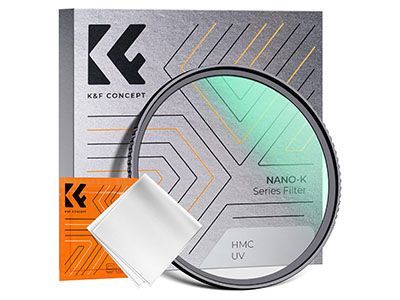
KF Concept
Various diameters
Gobe
Various diameters

Urth
Filter kit

NiSi Armor
Various diameters

- As an Amazon Associate, this website earn from qualifying purchases.