

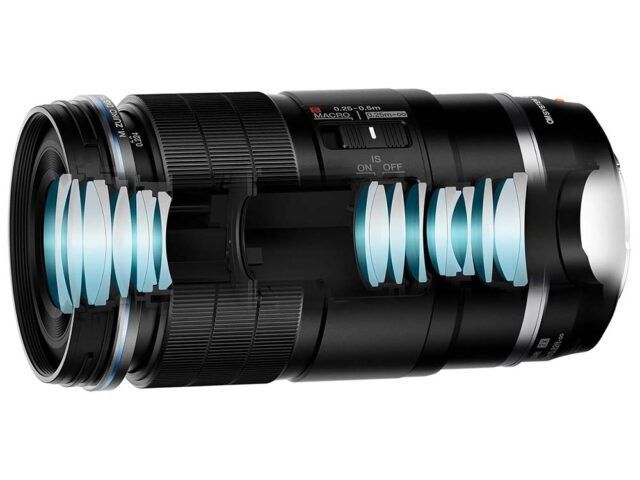
The OM System 90mm f/3.5 Macro IS PRO is a lens designed to fill a very specific niche within the Micro Four Thirds system: high-level macro photography. With a focal length equivalent to 180mm and a true magnification of 2:1, it stands above most native macro lenses in the system, which are usually limited to 1:1 ratios.
This extreme magnification capability, combined with built-in stabilization and professional-grade build quality, makes it a tool designed to deliver maximum performance in macro photography, although it is not without compromises that are worth examining closely.
Construction and Design
The 90mm f/3.5 maintains the aesthetic and build quality of the OM System PRO series: a sturdy body, resistant to dust, splashes, and low temperatures, with a moderate weight for its size, at 453 grams. Despite its physical length, it remains a manageable lens, although at this point we begin to rely on the grip offered by the camera body we use.
The focus ring design allows sliding to instantly switch between autofocus and manual focus, as well as displaying the distance scale and reproduction scale on the lens barrel. It also includes a customizable button (L-Fn), a focus range selector, and a 62mm filter thread.
Macro capability and working distance
One of the greatest advantages of this lens compared to others is that it allows for high magnifications without forcing you to get practically on top of the subject. Even at its maximum magnification (2:1), it offers a working distance of about 6 cm from the front of the lens, leaving enough space to properly light the scene and work with delicate or moving subjects.
The 2:1 ratio can be activated via an “S-Macro” switch, which internally adjusts the focus group to allow this level of magnification. The lens is also compatible with the MC-14 (1.4x) and MC-20 (2x) teleconverters, with which a ratio of up to 4:1 can be achieved. However, this comes at the cost of reduced brightness and possible diffraction.
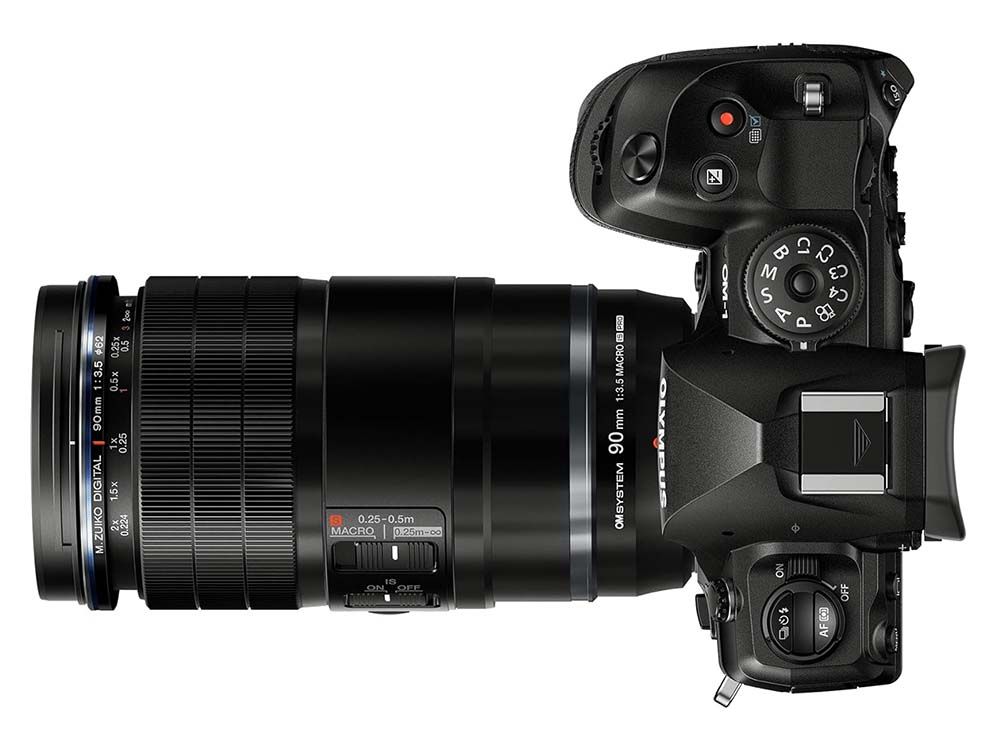
▌The OM System 90mm f/3.5 Macro IS PRO features a sliding focus ring that allows instant switching between autofocus and manual focus, as well as displaying distance and magnification scales on the barrel. It includes a customizable button (L-Fn), a focus range selector for greater precision, and a 62mm filter thread to facilitate the use of accessories.
Image Quality
Optically, the 90mm f/3.5 Macro IS PRO delivers outstanding performance. Even at f/3.5, it shows excellent sharpness and contrast in the center, with very well-controlled edges. Stopping down to f/5.6 achieves the optimal point, although improvements are minimal given the high level from the maximum aperture. Beyond f/8, diffraction starts to become noticeable, so focus stacking is recommended rather than excessively closing the aperture.
The lens handles longitudinal chromatic aberrations (also known as LoCA) very well. These occur when colors do not focus exactly at the same point, producing color fringes (usually green or magenta) in front of or behind the focus plane. This type of optical defect is especially problematic in macro photography, as it becomes more visible when working with very shallow depth of field and high detail.
In this case, the performance is excellent: even in out-of-focus areas, where this type of aberration is usually more noticeable, there are barely any traces of LoCA. This is especially valuable since these aberrations are difficult to fully correct in post-processing.

▌OM System OM-1 with M.Zuiko Digital ED 90mm f/3.5 Macro IS Pro. 1/200 s, f/14, ISO 200. Photo by Bridgette Gower

▌OM System OM-1 with M.Zuiko Digital ED 90mm f/3.5 Macro IS Pro. 1/100 s, f/8, ISO 200. Photo by Chris McGinnis

▌OM System OM-1 with M.Zuiko Digital ED 90mm f/3.5 Macro IS Pro. 1/250 s, f/10, ISO 200. Photo by Jamie Rosencrans

▌OM System OM-1 with M.Zuiko Digital ED 90mm f/3.5 Macro IS Pro. 1/80 s, f/8, ISO 1000. Photo by Lisa & Tom Cuchara
Focusing and Stabilization
The autofocus system is surprisingly effective (most macro lenses —regardless of their price range— tend to show limitations in autofocus at very short distances, due to the inherent difficulty of AF systems in those conditions), and it remains usable for macro work and highly reliable for general use. For maximum precision, manual focus —although electronic (“by wire”)— provides good control, especially when combined with focusing rails.
Image stabilization is one of the standout features of this lens. It includes a 5-axis stabilization system optimized for macro photography, known as Sync IS, which claims up to 7 stops of vibration compensation according to CIPA standards. This capability enables handheld shooting even at extreme magnifications, such as 4x (equivalent to 8x on full frame), without the need for a tripod. Additionally, when paired with compatible OM System bodies, Sync IS improves viewfinder stability and facilitates composition and focusing at maximum magnification.
About Sync IS
Sync IS is a technology developed by OM System that enables synchronization between in-body image stabilization (IBIS) and lens-based stabilization to achieve a combined compensation of up to 7 stops, as mentioned earlier. To take advantage of this feature with the M.Zuiko 90mm f/3.5 Macro IS PRO, it must be used with camera bodies that are compatible with Sync IS.
These include the most advanced cameras in the system, such as the OM System OM-1 and OM-5, as well as Olympus models like the E-M1X, E-M1 Mark III, E-M1 Mark II, and E-M5 Mark III. On the other hand, older models such as the E-M10 series (any version) or the E-M5 Mark II are not compatible with this technology. While they do have internal stabilization, they cannot combine it with the lens stabilization.
Bokeh and Optical Character
The background blur is generally attractive and smooth when shooting at normal distances. However, in extreme macro situations, it can become somewhat more unpredictable: in the presence of specular highlights or bright backgrounds, concentric rings (“onion rings”) and more nervous bokeh may appear. Without these elements, the blur maintains a soft character with pleasing transitions.
Versatile Uses Beyond Macro
Although it’s clearly designed as a macro lens, its focal length also makes it a valid option for compressed portraits or even short-distance nature photography. In these secondary uses, autofocus is fast and accurate, and stabilization remains a significant advantage.
Considerations and Limitations
- The electronic focusing system, while well-implemented, introduces slight latency, which can affect fine control in certain situations.
- Despite its excellent optical performance, it is not recommended to stop down beyond f/8 due to the risk of sharpness loss from diffraction.
- The high price clearly positions it as a tool for advanced users or professionals. It is not an entry-level lens, but rather an investment for those who specifically need its capabilities.
Conclusion
The Olympus 90mm f/3.5 Macro is an outstanding lens within the Micro Four Thirds system. It offers 2:1 magnification without the need for additional accessories, effective Sync IS stabilization, a robust build, and top-tier optical performance. All of this makes it a benchmark tool for photographers specializing in macro work.
However, it also raises a valid question: is it worth it compared to more affordable and lightweight alternatives? For instance, the Olympus 60mm f/2.8 paired with a Raynox close-up lens can reach up to 1.65:1 magnification, with image quality not far behind that of the 90mm. Additionally, this combo is more compact, lighter, cheaper, and more versatile—often a more practical choice for many photographers, especially those working with insects or outdoors for long sessions.
The 90mm makes sense when true 2:1 or even 4:1 magnification (with teleconverters) is needed, when longer working distance is highly valued, and when avoiding external accessories like close-up lenses is a priority. But for the majority of macro photographers, the 60mm with a Raynox may offer a more attractive balance of performance, portability, and price.
Buy the M.Zuiko 90mm f/3.5 Macro

Zuiko 90mm F3.5
Specs
- Mount: Micro Four Thirds
- Focal length: 90 mm (equivalent to 180 mm in full frame)
- Maximum aperture: f/3.5
- Minimum aperture: f/22
- Optical construction: 18 elements in 13 groups, including 2 SED lenses, 4 ED, 1 Super HR, and 1 HR
- Number of diaphragm blades: 7 (circular aperture)
- Minimum focusing distance: 0.224 m
- Maximum magnification: 2.0x (equivalent to 4.0x in full frame)
- Image stabilization: Yes; up to 6 stops with lens IS, and up to 7 stops with Sync IS on compatible bodies
- Focusing motor: VCM
- Internal focusing: Yes
- Focus limiter: Three positions: Macro, 0.25–0.5 m, 0.25 m–infinity
- IS switch: Yes
- Customizable L-Fn button: Yes
- Filter thread: 62 mm
- Dimensions: 69.8 mm diameter x 136 mm length
- Weight: 453 g (without caps or hood)
- Weather sealing: Yes; dust- and splash-resistant with IP53 rating
- Front element coating: Fluorine-coated to repel water and oil
- Included accessories: Front and rear caps, LH-66E lens hood, CS-53 wrapping cloth
Teleconverter Olympus MC-14
Specs
- Mount: Micro Four Thirds (MFT)
- Magnification factor: 1.4x (increases the focal length of the main lens by 40%)
- Light loss: 1 stop (1 EV)
- Optical design: 6 elements in 3 groups, including 1 HR (High Refractive) lens
- Coating: ZERO (Zuiko Extra-low Reflection Optical) to reduce reflections and flare
- Dimensions: Ø58.8 mm × 14.7 mm (excluding lens and mount protrusions)
- Weight: 105 g
- Build: Fully metal, dust-, splash- and freeze-resistant down to -10 °C
- Electronic communication: Maintains autofocus (AF), image stabilization (IS), and aperture control
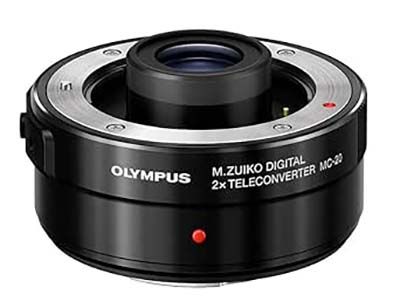
Teleconverter Olympus MC-20
Specs
- Mount: Micro Four Thirds (MFT)
- Magnification factor: 2x (doubles the focal length of the main lens)
- Optical design: 9 elements in 4 groups, including 1 HR (High Refractive) lens
- Light loss: 2 stops (2 EV)
- Coating: ZERO (Zuiko Extra-low Reflection Optical) to reduce reflections and flare
- Dimensions: 59.8 mm (diameter) × 25.9 mm (length)
- Weight: 150 g
- Weather resistance: Sealed against dust, splashes, and freezing down to -10 °C
- Electronic communication: Maintains autofocus (AF), image stabilization (IS), and aperture control
- As an Amazon Associate, this website earn from qualifying purchases.